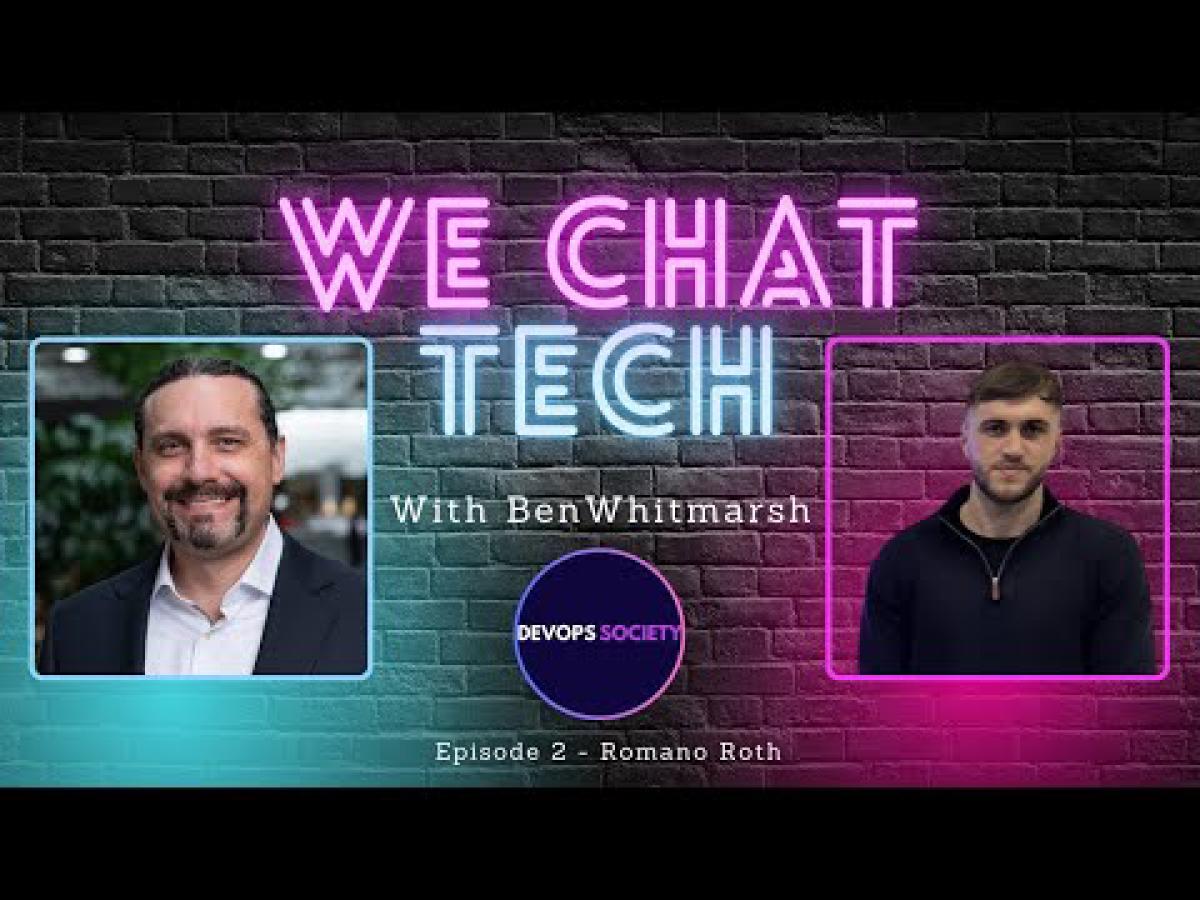
I recently joined Ben on the We Chat Tech podcast for a wide-ranging conversation about DevOps, leadership, career growth, and the future of AI in software engineering. Over 23 years at Zühlke, I have worked across industries helping organizations transform how they deliver software. In this episode, we covered everything from the fundamentals of DevOps to the skills that future engineers will need.
What DevOps Really Means#
For me, DevOps is about bringing all the people, all the processes, and all the technology together to continuously deliver value. It is not just about connecting development and operations. It is about the entire value stream, from the first idea all the way to the customer, and back again through monitoring and feedback.
Every company is at a different point in their DevOps journey. Some organizations have mature value stream teams and their own platforms. Others are still using file systems for version control. As a consultant, my job is to meet each organization where they are and help them move forward.
Value Stream Mapping: The Foundation#
When I enter a new engagement, the first thing I do is a value stream mapping exercise. You bring all the people working on a product into a room, give them Post-its, and ask them to lay out every step from idea to production. Then you measure three things for each step:
- Lead Time: The total time from start to finish of that step
- Process Time: The actual value-adding work time
- Percentage Complete and Accurate: How often the output is good enough to move forward without rework
The results are always eye-opening. Typically, one third of the total time is spent at the beginning, before a developer even receives a task. Managers are surprised by how much hidden waiting exists. Developers discover what happens before they get their Jira ticket. Operations learns about the full journey before something reaches them.
When you bring all these people together and suddenly they see the whole value stream, very interesting things happen. It is an eye-opener. They start to think in the whole system instead of their silo.
This whole-system thinking is the foundation for real cultural change. Only when people understand the entire value stream can they begin to act as one team with collaborative ownership.
Leadership and Growing People#
At Zühlke, education is a central part of our culture. Our people spend roughly 10 to 20 days per year on education and professional development. I have been mentored and coached throughout my career, and everything I am today is thanks to that mentoring, that coaching, and the education I received.
What makes a great leader in our industry? It comes down to communication, empathy, and the ability to see both strengths and weaknesses in people. Leadership is not management. It is about understanding what each person needs, whether that is coaching, mentoring, or something else entirely, and providing the right support so they can grow.
When it comes to problem-solving with my team, I encourage them to come up with their own ideas. We use the architectural trade-off technique: identify the problem, define a solution space with multiple options, establish evaluation criteria, and then evaluate together. This collaborative approach produces better outcomes and develops the team at the same time.
Retaining Talent#
Hiring the right people is essential. At Zühlke, we use a three-step interview process: first, cultural fit; second, understanding who we are and what we offer; third, a three-hour technical deep dive to determine fit and level. But hiring is only half the equation.
Retaining talent requires giving people awesome projects, showing them a career path, coaching them through their growth, and letting them see that they are getting better every day. When people feel that kind of progress, they stay.
AI in Software Engineering: A Tool, Not a Replacement#
AI will play a significant role in the future of technology, but we need to be realistic about where it helps today. For coding, AI assists with boilerplate and routine tasks. But when you need to create something genuinely new, develop a new algorithm, or solve a novel problem, it does not help yet.
There is a real danger that AI makes people stop thinking. Critical thinking and problem solving will become the most important skills for future engineers. The comparison to history is useful: when we introduced object-oriented programming, there was a risk of laziness around memory management. We had issues until standards emerged. The same will happen with AI. People will get lazy at first, problems will surface, and then we will develop expertise and standards for using AI well.
AI is just the next level. When Java came along, people said we would need fewer developers. That was not true. AI will follow the same pattern: we will use it to create more awesome stuff that is more complex.
For practical AI applications in DevOps, the results are already impressive. We built a platform for a bank in Liechtenstein where we integrated a large language model for log file analysis. Developers click a button, the model analyzes the logs, and they can act on the findings. The feedback from developers: “This is absolutely awesome. It helps us massively in finding and analyzing problems.”
Advice for Young Engineers#
My biggest piece of advice: never stop learning. Stay up to date with technology, and do not focus too narrowly on one language or stack for too long. Today, tools like GitHub Copilot make it easier than ever to switch between languages. Becoming a polyglot programmer is more achievable and more valuable than it has ever been.
I focused heavily on C# for many years. Looking back, it would have been more beneficial to switch between languages earlier. The industry now expects engineers to be comfortable with multiple languages, and platform teams especially need people with broad technical skills.
Key Takeaways#
- DevOps is about the entire value stream, not just development and operations. Start with value stream mapping to understand where you are.
- Whole-system thinking is the foundation for cultural change. When people see the full picture, they stop thinking in silos.
- Great leadership is about empathy and growth. See what each person needs and provide the right support.
- Retain talent through meaningful work, education, and visible career progression.
- AI is a powerful tool, not a replacement. It helps with routine tasks but cannot substitute for critical thinking and problem solving.
- Never stop learning. The best investment you can make is in your own continuous education and breadth of skills.