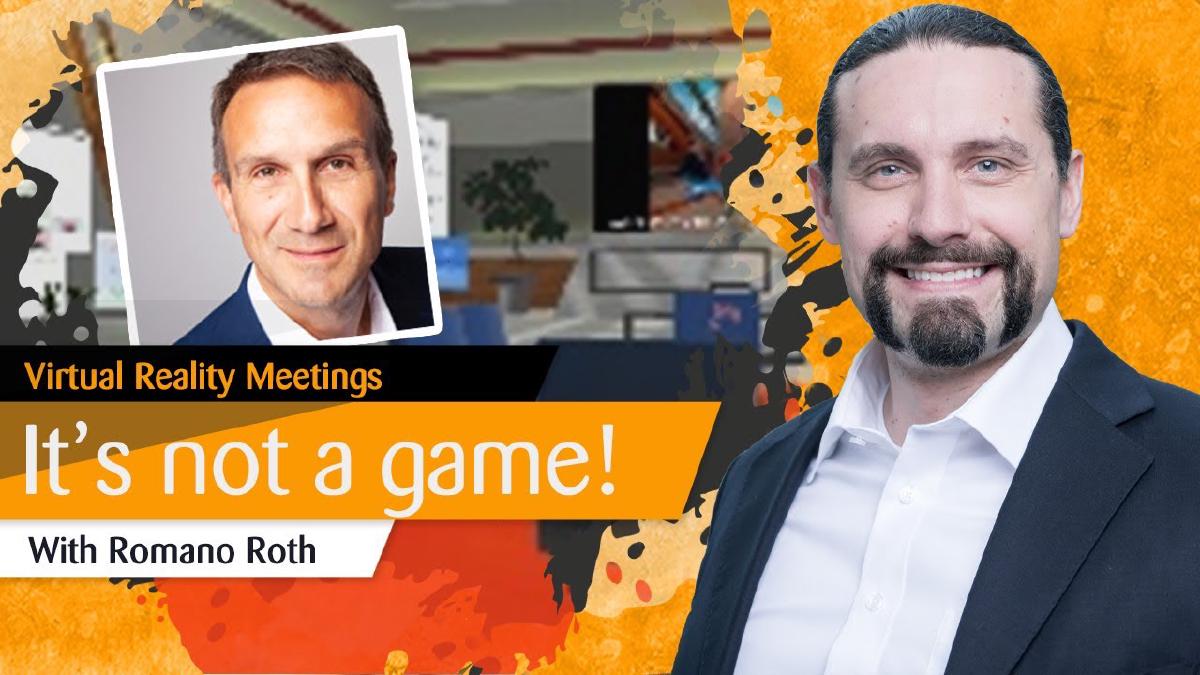
What happens when you skip the plane, the traffic and the Zoom fatigue and simply meet a colleague in a virtual office on another continent? In this conversation, I jump into VR to visit Michele at BCVR. Within a click I am standing next to him in Chicago, coffee in hand, looking over diagrams on the wall and exploring what it really means to work, train and collaborate in the Metaverse. This is not a demo of a gaming toy. It is a look at a serious business environment that, even in 2021, already feels remarkably close to the future of work.
Arriving in a Click: Presence Instead of Pixels#
The first thing that strikes me when I put on the headset is how quickly the idea of distance disappears. I am sitting at my desk in Switzerland, Michele is in Munich, and yet we are standing next to each other in a bright, spacious room in Chicago. He hands me a cappuccino. It is still warm, at least in the logic of the space.
What makes this different from Teams or Zoom is not the visuals, it is the sense of presence. Michele’s voice gets louder as he walks closer to me and softer as he moves away, exactly like in real life. I can hear him from my left, I can hear him from my right, and my brain reacts as if someone were actually standing beside me. Feedback from people who join trainings in this environment points in the same direction: they say they feel close to their working partner, not like they are staring at a 2D face behind a flat rectangle.
That small physical cue, position, proximity, direction, is what turns a video call into a meeting you actually remember.
The Return of the Coffee Machine Chat#
One thing we both miss most in the pandemic is the informal side of office life. The two-minute conversation at the coffee machine. The quick exchange of ideas in a hallway. The question you would never schedule a meeting for but that often changes a project.
Teams and Zoom have mostly killed that layer. We have the formal information flow, boss to team and back, but the informal flow has collapsed. Michele and I talk about this while walking around the virtual room. And that is exactly the point. Because you walk, because you bump into each other in a shared space, the informal layer quietly comes back.
For me, sitting in front of a laptop since early morning, this was the most surprising part. Standing up, walking around, talking to a real person in front of me, even a virtual one, simply feels better than yet another flat video call.
Getting People Out of Their Bedroom#
Michele tells me about one participant whose apartment is so small that his desk stands in his sleeping area. He wakes up, puts on something presentable for Teams, works a full day, and at night goes back to bed two steps away. Nothing in his environment changes between work and rest.
VR is not a solution for housing, but it is a way out of that room, at least mentally. The moment you step into a wide virtual space, with depth, light and a view, your brain registers a real change of location. You walk, you look around, you interact with objects. For hybrid and remote workers who live in small spaces or in permanently dim rooms, that shift matters more than it might sound.
Michele switches us into a classical training room with a panoramic view over Austria. It is mid-afternoon in Switzerland, already getting dark outside my real window, but here the light is bright and warm. That contrast alone changes how I feel in the conversation.
Real Collaboration: Whiteboards, Diagrams and PI Planning#
The next question I had was obvious. Is this actually useful for serious work, or just a nice backdrop?
Michele walks to a whiteboard. As he approaches, a pen appears in his hand. He starts sketching a class diagram, we add comments, we attach post-it notes to a virtual table. He demonstrates how existing documents from a shared drive can be pulled into the room, annotated together and taken back out. PDFs work well because they are lightweight. PowerPoints can be shown but not edited inside the room yet. Word is similar. These limitations are real, but as Michele puts it, “it’s a matter of time as the things are evolving quite strong and quite fast.”
Then he shows me something I find genuinely impressive. He drops a few 3D objects into the room, labels one “interest”, duplicates it, labels the next one “buying”, connects them with an animated arrow, and suddenly we are standing inside a process diagram we can walk around. For architectural discussions, for organizational charts, for process design, this is a different category of collaboration. You do not just look at a diagram, you stand inside it.
He also mentions that they run SAFe-style planning sessions in these rooms, with around 40 people. It gets loud when everyone gathers, then each group moves into its own area and the sound naturally fades with distance. That is something no 2D tool can replicate with the same intensity.
Beyond the Office: Why Space Becomes Infinite#
At some point Michele takes us outside, onto a virtual campus. Bright sun, open sky. He adds palm trees with a click, then deck chairs, one for each of us. We keep talking, but the environment has shifted from a conference room to something that feels like a short break.
Behind that playful moment sits a serious business question. What do you do with large, empty physical office spaces when most of your people work remotely? During the pandemic, a lot of floor space in corporate buildings turned into dead capital. Some of the organizations Michele has spoken to are thinking about turning parts of those rooms into VR offices: smaller physical footprints, equipped so that people can step into huge shared virtual spaces with colleagues around the world.
As Michele jokes, they already have more space than any big company, because they can multiply rooms as often as they want. That is the point. In the Metaverse, square meters stop being a constraint.
The S.L.H Era: Smartphone, Laptop, Headset#
We naturally end up talking about the future. Michele is convinced that within five years, most knowledge workers will routinely meet in VR, and that headsets will evolve into glasses. I share a perspective I wrote about with Paul in a short article: the coming age of the S.L.H employee. S for smartphone, L for laptop, H for headset. Depending on what you need to do, you pick up one of the three. A quick message on the phone, focused work on the laptop, collaborative and immersive work in the headset.
This is not science fiction. With new generations of Oculus hardware, with Apple and Samsung entering the space, resolution, comfort and interaction quality are moving fast. Michele expects the new normal to arrive within the next 18 to 24 months for early-adopting companies. That is why I bought my own headset: you need time to get comfortable with the interaction model, with the feel, with the etiquette. Waiting until everybody else is already there means starting the learning curve too late.
It’s Not a Game, It’s Business#
The biggest misunderstanding about VR today is the association with gaming. Yes, the technology grew up in gaming. Yes, it looks playful. But the psychology behind it is exactly the reason it works so well for business. We know from research that when people learn in a playful, immersive state, they absorb content faster and retain it longer. Joy and work are not opposites, they amplify each other.
What I experienced with Michele was not entertainment. It was a working session with whiteboards, diagrams, processes and a conversation about strategy, just in an environment that made all of it more engaging and more memorable. The challenge for the industry is to communicate that clearly: this is not about shooting and running, it is about exchanging, designing and experiencing together.
And once you have been in, the argument makes itself. Everyone I have seen step into a space like this comes out with the same reaction: wow, this is easy, and this is going to change how we work.
Key Takeaways#
Presence beats pixels. Spatial audio, walking, proximity and a shared 3D space turn a meeting from a video call into something your brain treats as real. That is the foundation everything else is built on.
Bring back the informal layer. The most underrated benefit of VR collaboration is the return of coffee-machine conversations, hallway chats and spontaneous exchanges that Teams and Zoom have quietly killed.
Use VR where 2D tools hit their limits. Whiteboards, architectural diagrams, process design, big-room planning with dozens of people: these are the use cases where VR clearly outperforms flat tools today.
Rethink physical office space. Empty corporate floors are dead capital. Smaller physical hubs combined with shared VR environments can replace large office footprints and give teams more space, not less.
Prepare for the S.L.H era. Plan for a workforce that switches fluidly between smartphone, laptop and headset. The sooner your organization builds that muscle, the smoother the transition will be.
Start experimenting now. The learning curve is real: interaction, etiquette, tool fluency. Companies and individuals who begin today will have a clear advantage when VR becomes the new normal over the next 18 to 24 months.