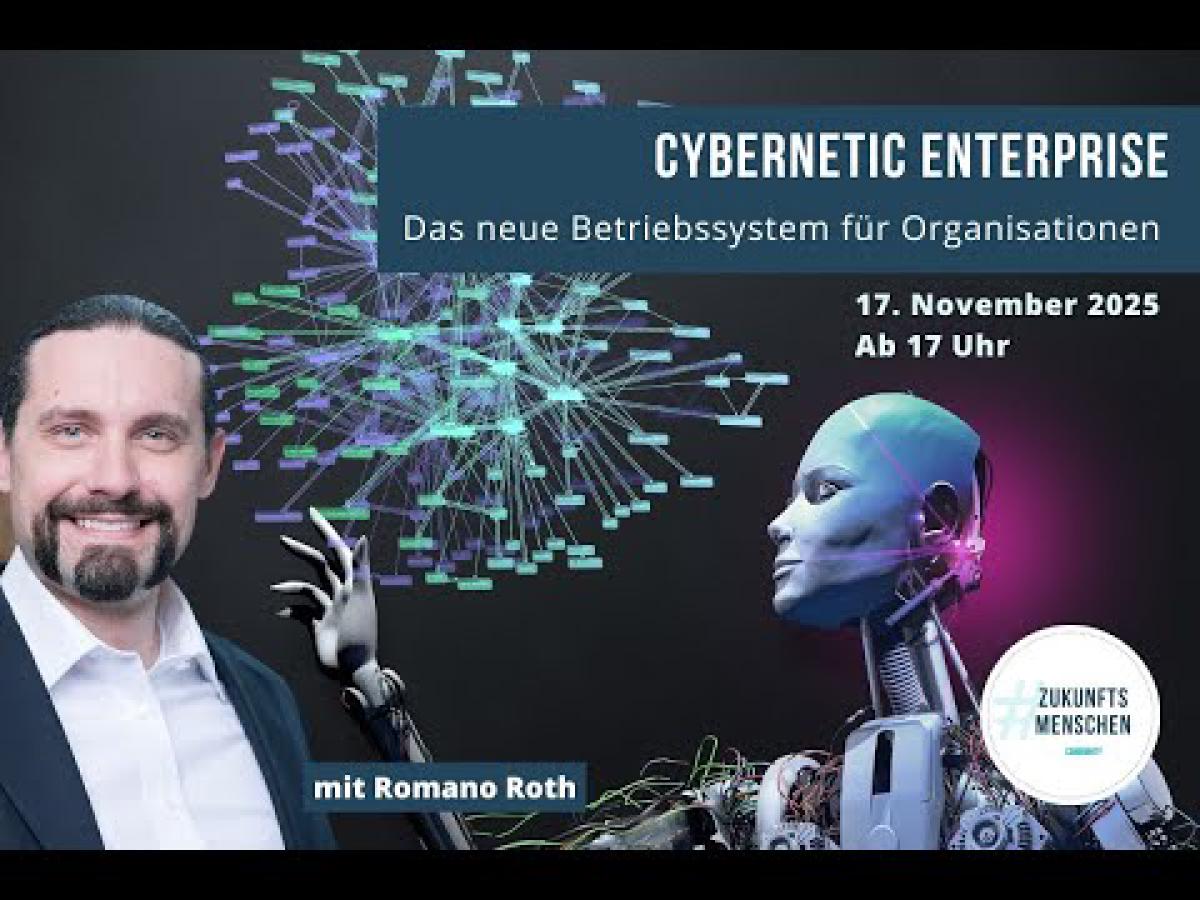
Most companies that work in an agile way today while simultaneously trying to implement AI will not survive the next decade, in my opinion. The reason: their operating system is too old. The future is not agile. The future is not AI either. The future is cybernetic.
In my talk at the Zukunftsmenschen community, I explain what the Cybernetic Enterprise is, why organizations need a new operating system, and how to approach such a transformation in practice. The talk is in German.
Why the Traditional Model Is Reaching Its Limits#
We implement Agile, we implement DevOps, some adopt SAFe, and of course now we are all doing AI as well. We want to move faster, but somehow we keep getting slower. The reason is that the traditional model in our companies has completely reached its limits.
We have silos: business silos, IT silos, security silos. We have governance and processes that we dress up in agile clothing. We introduce agile roles, but everything is still waterfall underneath. Then we launch a digital transformation that does nothing more than digitize the old structures.
My observation: we are currently optimizing for speed. But agility is really about steerability and resilience, the ability to react quickly to change. Most companies focus on AI tools, but the operating system of the organization is outdated and never truly gets updated.
What Cybernetic Actually Means#
The term “cybernetic” is older than the term AI. It was coined in the early 1940s, and at its core it says something quite simple: humans and machines (including AI) work together in continuous feedback loops to continuously create value.
This concept fascinates me because it describes exactly what today’s organizations need. It is not about replacing people with AI. We need to make people better with AI. That is a fundamental difference.
The Five Steps Before Automation#
Too often we focus on which processes we can automate. Years ago I outlined five steps that must be followed:
- Question the requirements. Put a name behind every requirement: who is the owner?
- Ruthlessly eliminate. What is truly unnecessary in this requirement?
- Simplify. Make the remaining requirements as simple as possible.
- Optimize. Only after simplifying do you optimize.
- Automate. Automation comes last.
The problem: we spend all our time on step 5. With everything happening around AI right now, most companies only care about the last step. But the processes and requirements behind it are never questioned.
The Mental Model of the Cybernetic Enterprise#
In the Cybernetic Enterprise book, I developed a mental model that spans from purpose all the way down to tools. It represents the layering of an organization:
- Purpose defines the vision (a 1:1 relationship)
- Vision guides the mission
- Mission shapes the values
- From the values we derive principles (I have identified 16 principles)
- Principles define capabilities (business and IT)
- Capabilities lead to practices (55 in total)
- From practices we derive processes
- And only then come the tools
Too many discussions start with the tools. That is like building a house starting from the roof. This mental model shows that tools are the last element, not the first.
Three Core Principles#
Among the 16 principles of the Cybernetic Enterprise, three stand out:
Organize along the value stream. This is the biggest lever you have, and at the same time the lever that the fewest organizations actually use. Many are afraid of this change, but it solves a great number of problems.
Empowered teams. Autonomous teams that independently own part of a product or an entire product and can deliver completely on their own.
Data-driven decisions. This is the foundation for feedback loops: making decisions based on data and facts. It also enables AI to automate certain decisions.
Three Core Practices#
The CEO as Chief Evangelist. This cannot be delegated. The CEO must be the influencer for the Cybernetic Transformation. Without that, it will not work.
Continuous improvement at all levels. Not just retrospectives in individual teams, but at every level of the organization, on a weekly or biweekly cadence.
The Cybernetic Platform. The foundation, the backbone of the Cybernetic Enterprise. A self-service product within the company whose customers are the product teams. This platform provides the capabilities, tools, and processes the teams need.
How to Start the Transformation#
My clear recommendation: start small. I would never roll out a full Cybernetic Transformation across an entire company. The path looks like this:
Start in one area. Make the value stream visible. By making it visible, you see where the bottlenecks are. Analyze the current value stream, identify the bottlenecks, and derive the future value stream from there.
Identify and close critical feedback loops. On the way to the future value stream, establish the most important feedback loops.
Consciously establish one AI-augmented decision. If most companies want to do something with AI, they should do something meaningful: introduce one concrete, AI-supported decision.
From there, you move through the organization value stream by value stream.
AI Washing and the Reality Check#
In the discussion with the community, I also talked about the current hype. There are companies that advertise massive savings through AI. My assessment is nuanced: an MIT study shows that only about 5% of companies actually see a positive impact on their profit and loss statement from AI. 95% do not.
There is also a lot of AI washing going on. Companies label things as AI, but it is really just traditional automation or process optimization. Of course there are great cases, and at Zuhlke we have delivered some top cases as well. But you need to be careful with big numbers projected across an entire company.
Culture as the Biggest Hurdle#
The hardest dimension of any transformation is the cultural transformation. You potentially have an entire layer of middle management that the new structure no longer needs. You have to work with these people: how does their role transform?
Age has nothing to do with it. I have met board members at retirement age who are fully engaged with AI, and 40-year-olds who are completely resistant to change. It has more to do with attitude and mindset than with age.
What matters is what John Kotter described in “Leading Change”: is management standing on a burning platform? Is there a real need for change? If not, there will be no change. And then you need to communicate that clearly: without top management support, the impact will remain small.
“The future belongs to those who master the symphony of organization, processes, technology, and AI.”
Key Takeaways#
- The operating system must change, not just the tools. Putting AI on top of old structures yields little. You need a new organizational operating system.
- Question first, automate later. The five steps (question, eliminate, simplify, optimize, automate) are essential before deploying AI.
- Feedback loops are the key. The Cybernetic Enterprise is a learning system with permanent feedback loops at all levels.
- Organize along the value stream. The biggest lever, but also the biggest cultural shift.
- The CEO must be Chief Evangelist. This transformation cannot be delegated.
- Start small, value stream by value stream. Large transformations fail. Transform one area first and expand from there.
- The Cybernetic Platform as the foundation. A self-service product for the product teams that provides capabilities, tools, and processes.