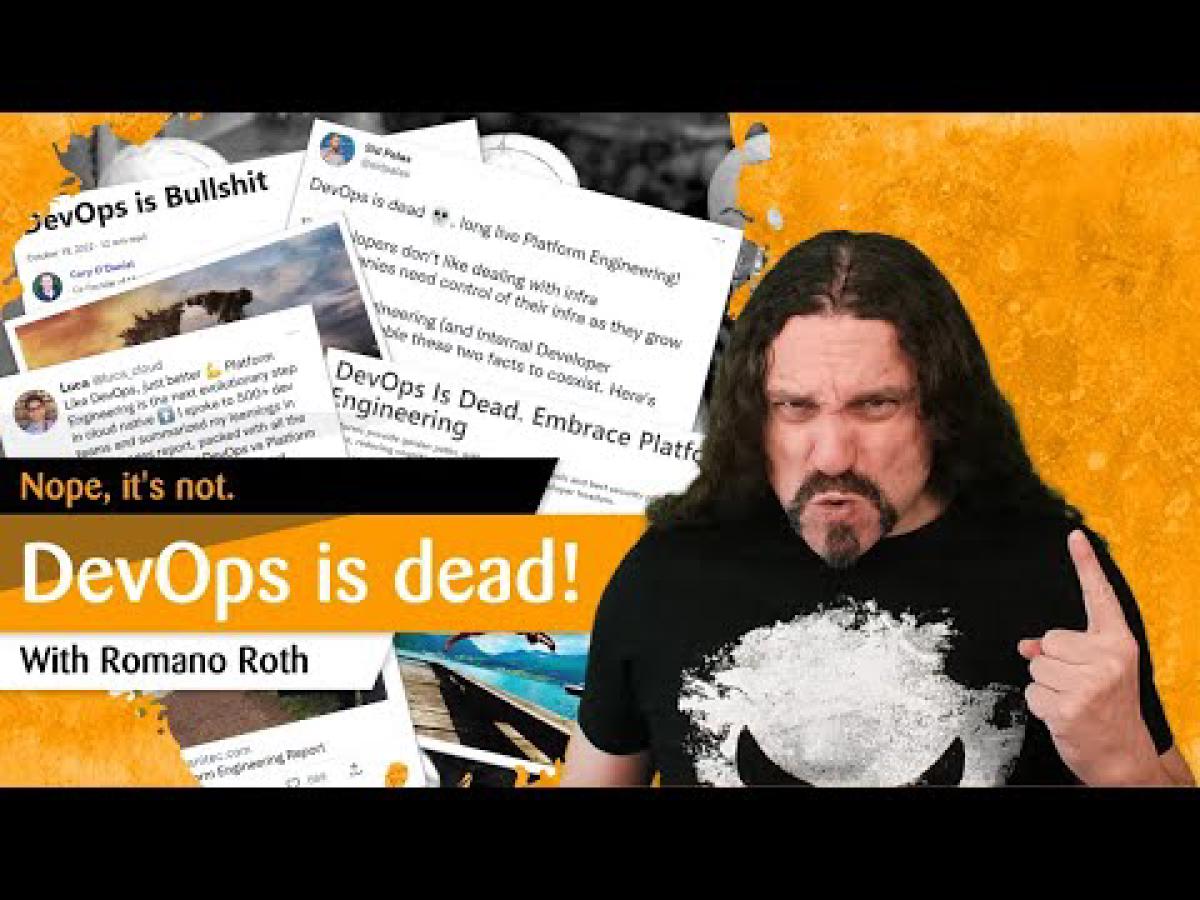
The internet is full of posts claiming that DevOps is dead. “DevOps is bullshit.” “Platform Engineering will replace DevOps.” “SRE is the future.” In this video, I explain why all of these claims are wrong, where they come from, and how DevOps, Platform Engineering, and Site Reliability Engineering actually relate to each other.
Today’s Broken Value Streams#
To understand why “DevOps is dead” posts exist, we first need to understand today’s challenges. In most enterprises, the picture is the same: Business writes great plans, throws them over the wall of confusion to Development. Development implements something and throws it to QA. QA tests something that does not match the spec and throws it to Operations. Operations says it will never work in production. And the customer says: “This is not what we wanted.”
The value stream is broken by walls of confusion that come from the silo organization. The silos themselves are not the real problem. The real problem is the lack of alignment between them, because these organizational units have different goals and can even cancel each other out.
“DevOps is a mindset, a culture, and a set of technical practices which provides communication, integration, automation, and close collaboration among all the people that need to plan, code, build, test, deploy, release, operate, and monitor a product.”
The DevOps Naming Debate#
The term “DevOps” is Development plus Operations. Many people think it is only about bringing Dev and Ops together. It is not. Some smart people proposed “DevSecOps” because security is important. Others proposed “BizDevOps” because business is important. But none of these terms capture the full picture. We would need “DevSecBizArchCompQAOps” to be complete. So we just call it DevOps, because DevOps is about bringing all the people, processes, and technology together to continuously deliver value.
Common Anti-Patterns#
The “DevOps is dead” posts come from misled or insufficient implementations. Here are the most common anti-patterns:
The DevOps Silo: Management says “we need some of this DevOps thing,” keeps the Dev and Ops silos, and creates a new DevOps silo between them. This just adds more walls of confusion and more handoffs. Do not do this.
The Remote DevOps Silo: Management says “we need DevOps, but let us outsource it to a cheaper location.” This is even worse than the previous anti-pattern. Also do not do this.
The goal is clear: Dev and Ops (and all other roles) should come closer and closer until they become one team with the same goals, fully aligned to product delivery.
The Scaling Challenge#
One team doing DevOps on one product works beautifully. But what happens when you have multiple teams on multiple products? Each team uses its own tools and platforms. You get massive redundancy, inconsistency, and friction. Development teams may lack operational experience, leading to cognitive overload from the complexity of managing all the tooling themselves.
Some companies respond by creating a shared operations team in the middle. This reduces cognitive load and brings consistency, but it reintroduces the silo problem.
Platform Engineering: The Better Approach#
The better solution is Platform Engineering. You keep all the product teams working on their products with DevOps practices. But instead of a shared ops silo, you introduce a platform team that builds and maintains a platform where all products can be built and maintained.
Each product team retains its own product operations as a sub-team or dedicated people who operate the product. The platform team provides the foundation: runtime, developer experience, CI/CD pipelines, identity management, and observability. Product teams still follow “you build it, you run it.”
The key insight: customers do not pay for your platform. They pay for your products. But the platform generates value for your teams, enabling them to build better products. Platform Engineering enables DevOps in your company.
“Platform Engineering uses DevOps practices so that they can deliver a platform where product teams can build their products and do DevOps.”
Site Reliability Engineering: DevOps for High Availability#
There is also confusion about whether SRE (Site Reliability Engineering) will replace DevOps. SRE was introduced by Google in 2004. It is about building highly available, highly reliable, highly scalable systems.
The distinction is practical. When your system needs two nines of availability (14.4 minutes downtime per day), you do DevOps. When you need five nines (864 milliseconds downtime per day), you need SRE. Site Reliability Engineers are T-shaped people who know a lot about both operations and development. They use DevOps practices to build and maintain systems that need extreme reliability.
Engineering a five-nines system is vastly more complex and time-consuming than a two-nines system. SRE is not a replacement for DevOps. It is a specialization that uses DevOps practices for high-availability scenarios.
The Thought Model: How It All Fits Together#
I use the following model to visualize the relationships:
- Lean (1940s): The Toyota Production System, the foundation of everything.
- Agile (2000): The Agile Manifesto, built on Lean principles.
- DevOps: Built on Agile and Lean. Bringing all people, processes, and technology together to continuously deliver value.
- Platform Engineering: Uses DevOps practices to deliver a platform that enables product teams to do DevOps.
- SRE: Uses DevOps practices to build highly scalable, highly reliable, highly available products.
DevOps is not dead. It is the foundation that Platform Engineering and SRE build upon.
Key Takeaways#
“DevOps is dead” comes from bad implementations. When companies create DevOps silos or outsource DevOps to cheap locations, it fails. That is not a problem with DevOps. It is a problem with the implementation.
DevOps is about all the people. Not just Dev and Ops. Security, business, architecture, compliance, QA, and everyone else working on the value stream.
Platform Engineering enables DevOps at scale. It provides the standardized foundation so product teams can focus on delivering value instead of reinventing tooling.
SRE is a DevOps specialization. It uses the same practices for systems that require extreme availability and reliability.
The foundation is clear. Lean enables Agile. Agile enables DevOps. DevOps enables Platform Engineering and SRE. None of them replace each other.