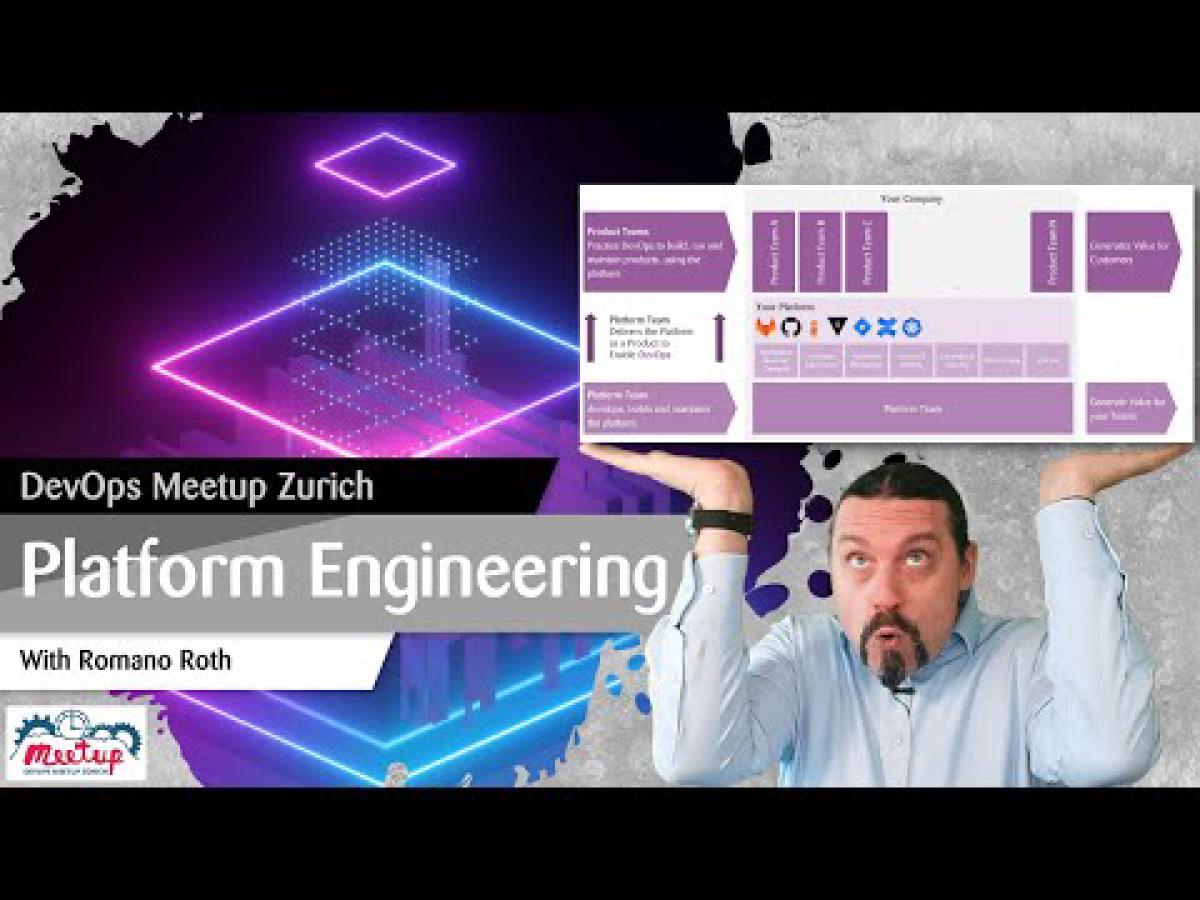
This is a recording of my presentation at the DevOps Meetup Zurich from January 2024. The talk covers Developer Experience and Platform Engineering, including why Platform Engineering has emerged, how it fits into the Digital Factory concept, and a live demo of the Platform Plane, the internal developer platform we built together with LGT.
The Problem: Walls of Confusion#
In many companies, the picture looks like this: business creates requirements in Word documents and Jira tickets, then throws them over a wall of confusion to development. Development implements something and throws it over another wall to testing. Testing checks it, and it goes over yet another wall to operations. Operations struggles to get it running, and the end result reaches the customer or business, who says: “What is this? This is not what we wanted.”
The root cause is the silo organization. Business, development, testing, and operations all work in separate silos with different goals. There is no alignment. The value stream is broken by these walls of confusion. And working in such an environment is not fun, so the developer experience is quite low.
DevOps is a mindset, a culture, and a set of technical practices which allows us to organize ourselves across the value stream so that all people work together on a product, not on a project.
Is DevOps Dead? The Cognitive Load Problem#
Science has looked at DevOps extensively. The book “Accelerate” and the State of DevOps reports show impressive numbers: high performers achieve 973 times more deployments to production than low performers. DevOps delivers faster time to market, more value for money, higher quality, higher customer satisfaction, and top qualified employees.
So why the articles claiming “DevOps is dead” and “Platform Engineering is the new trend”? The answer lies in cognitive load. When teams embrace “you build it, you run it,” they need infrastructure, container runtimes, CI/CD pipelines, monitoring, security tooling, cost management, access and identity, and they still need to implement features. When you multiply this across multiple product teams, the inconsistencies, redundancies, and complexity become overwhelming.
The Digital Factory: Scaling DevOps#
The solution is not going back to silo IT. The solution is the Digital Factory model. At the top level, a board of directors has a vision and a portfolio of ideas. The product management level breaks big ideas into features. Product teams work in an agile way, breaking features into user stories.
When a new team needs to start, the Platform Engineering team provides them with a standardized CI/CD pipeline so they can begin delivering value immediately. The whole system works in the three ways of DevOps: continuously delivering fast value, getting feedback back, and continuously learning.
The Digital Factory has four layers:
- Lean Portfolio Management connecting strategy with execution
- Product Management organizing multiple teams working on products
- Product Teams doing DevOps and owning their products
- Platform Team creating the foundation that enables teams to do DevOps
Platform Engineering in Detail#
The most important thing about Platform Engineering: the Platform Team creates an internal product that contains all the tools needed to deliver the company’s products. This includes application runtime, developer experience tooling, access and identity, observability and monitoring, and the CI/CD pipeline.
A critical distinction: the Platform Team does not operate the products. It enables the teams to operate their own products. The product teams create their own CI/CD pipelines and dashboards based on the platform. The Platform Team generates value for the teams, and the product teams generate value for the customer.
Gartner predicts that Platform Engineering is one of the strategic technology trends of 2024. By roughly 2027, they predict that 75% of organizations will have adopted or created their own DevOps platform.
The Platform Plane: A Live Demo#
Last year, LGT, a private bank in Liechtenstein, came to Zühlke wanting to create such a platform. They wanted a co-investment to build a platform and put it into an association so others could use it too. Together we built the Platform Plane and established the Open Platform Plane Association.
The platform includes:
- Application Runtime with Kubernetes as a service, API Gateway, and Service Mesh
- Developer Experience with a portal, CLI, and tunneling into clusters
- Automated DevSecOps with secret detection, license scanning, and static application security testing
- Access and Identity allowing morning onboarding and afternoon offboarding with immediate effect on all tools
- Centralized Security with network separation and policy enforcement
- Observability with automatically created dashboards and FinOps tracking
- GitOps with CI/CD pipelines, repositories, and secret management
In the demo, I showed how the portal integrates tools like GitLab, Kubernetes, Grafana, Argo CD, and HashiCorp Vault through adapters. This adapter pattern is key: it allows any tool to be replaced when needed, as long as it has an API.
The platform automatically scans repositories for security issues, rotates secrets when found in source code, creates documentation, and provides container image vulnerability analysis. When adding a new application like Microsoft SQL Server, everything is set up in a fully standardized way, including naming, passwords, sizing, dashboards, and observability integration.
We are entering the Age of Industrialization of Software Development. Platform Engineering builds the foundation of your Digital Factory and enables your teams to do DevOps.
Key Takeaways#
- Walls of confusion from silo organizations break the value stream and kill developer experience
- DevOps is not dead. Platform Engineering enables teams to do DevOps by reducing cognitive load
- The Digital Factory model connects strategy with execution through Lean Portfolio Management, Product Management, Product Teams, and a Platform Team
- The Platform Team creates an internal product for other teams. It does not operate the products.
- The Platform Plane demonstrates what an enterprise developer platform looks like in practice, with integrated DevSecOps, observability, and self-service capabilities
- By 2027, Gartner predicts 75% of organizations will have their own DevOps platform