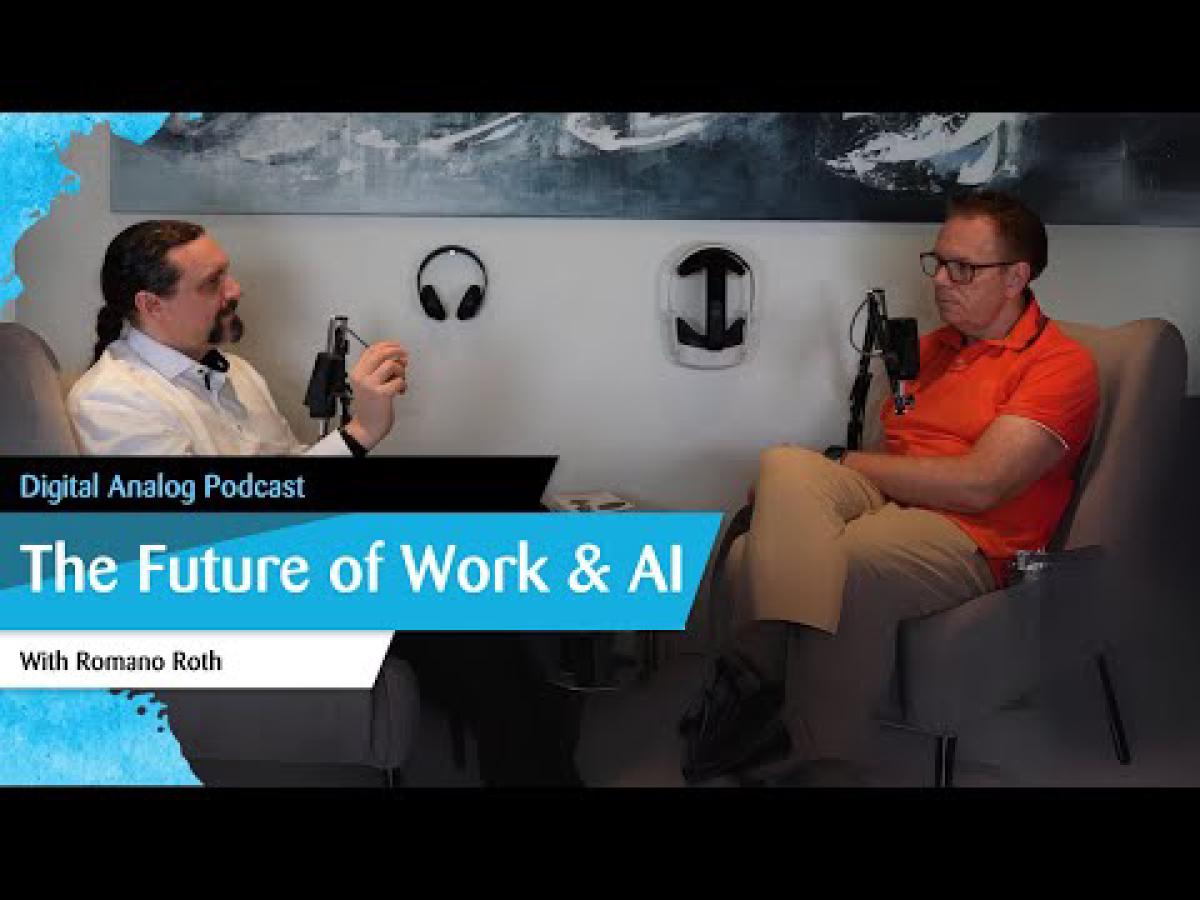
I recently joined the Digital Analog Podcast to talk about what it really means when humans and machines work together. As the Chief of Cybernetic Transformation and Partner at Zühlke, I deal with these questions every day. In this conversation, we covered everything from the biggest obstacles in digital transformation to why AI agents could change the way we collaborate, and why simplicity should be every organization’s guiding principle.
What is Cybernetic Transformation?#
The term “cybernetic” was coined in the 1940s, long before AI became a buzzword. At its core, cybernetics describes how humans and machines collaborate in a constant feedback loop, learning and improving continuously. This is exactly what I see as the future of organizations.
My role at Zühlke is to help companies design their processes, organization, and technology foundations so they can continuously deliver value. That is cybernetic transformation in practice. The term is not widely known, which has its downsides, but also an advantage: it sparks curiosity and invites good conversations.
The Biggest Obstacles Are Not Technical#
When I am asked about the biggest challenges in digital transformation, my answer surprises many people: the problems are rarely technical. Yes, there are legacy applications and outdated technology landscapes, but these can be solved with the right resources and investment.
Process challenges are also solvable. Over time, processes get ingrained and need to be adapted to new technical possibilities. That is manageable.
The really tough problems are organizational. Companies have built hierarchies and silos that made perfect sense in the past. Each business unit focused on its specialty and did it well. But now, as organizations need to accelerate, these silos block the flow of value across unit boundaries. The value stream runs through multiple business units but keeps getting interrupted.
The biggest obstacle is middle management. Not because they are doing something wrong, but because they are in an identity crisis. There is real fear of job loss, loss of purpose, and loss of the organization they built and were proud of. With that fear comes resistance, and overcoming that resistance is the toughest challenge in most organizations.
Value Stream Mapping: A 1940s Tool for Today’s AI Challenges#
One of the most effective techniques I use with clients comes from the Toyota Production System of the 1940s: value stream mapping. You analyze the entire stream from start to finish, identify each step, measure it, and suddenly the whole team, including management, can see exactly where the problems are.
Visualization is a powerful instrument. Instead of having a diffuse feeling that something is not working, you have a concrete map that shows where the bottlenecks, handoffs, and waiting times are.
This becomes especially interesting with AI. When companies come to me saying “we want to use AI,” I always say: let us first analyze your value stream. Based on that analysis, we can see where AI actually adds value. And here is the critical insight: AI is not deterministic. Every time you run it, you get a slightly different result. So if you need exact, repeatable outcomes, classical automation is the better tool. AI is the right choice where you can tolerate some variance and where the creative, pattern-matching capabilities shine.
AI Accuracy: The 60-95% Rule#
From our project experience, a consistent pattern emerges. Without any optimization, AI output is correct about 60% of the time. With proper prompt engineering and testing, you can push that to about 95%. But getting beyond 95% becomes extremely expensive and time-consuming.
I shared a concrete example from a project with an insurance company. They had many insurance policies and support staff who could not memorize them all. We built a RAG system (Retrieval Augmented Generation) as a chatbot on top of all policies. The interesting benchmark was that their own employees were wrong about 5% of the time. That became our target, and we reached it. But pushing beyond that proved very difficult.
It is fascinating: we often talk about AI accuracy, but we forget that humans are not 100% accurate either.
AI Agents: The Next Frontier#
One topic that truly excites me is AI agents. I compare them to having a personal assistant who is specialized in specific tasks. In the future, your Outlook assistant might negotiate meeting times with my Outlook assistant. They will find a slot, book it, and we will simply meet in Zürich without even knowing exactly how it happened.
This is where the collaboration between humans and machines becomes very real. As a manager, you might no longer have human employees for certain tasks. Instead, you might orchestrate 100 agents, checking in on their progress and providing feedback. The roles will change, but the work will not disappear.
We Keep Getting More Efficient, But Where Does the Time Go?#
I always find it fascinating to look back. When I studied, researching a topic meant going to the library, working through the card catalog, spending hours finding the right books. Today we can search online, read papers instantly, even have AI summarize entire books for us.
And yet, nobody seems to have more time. That is the paradox. We can now build more complex programs with less code, but instead of needing fewer programmers, we need more, because we tackle ever more complex problems. The same pattern repeats with every technology leap, from assembly to C++, from Java to AI-assisted coding.
We have always gotten more efficient, but we use that efficiency to tackle ever more complex challenges. The time savings never arrive.
Simplicity Wins#
One of my strongest convictions is that we need to simplify. We can build increasingly complex things, but truly mastering that complexity is extremely hard. I see more and more organizations that need to go back to basics: simpler processes, simpler organizational structures, simpler solutions.
Apple internalized this perfectly: if something is simple, make it even simpler. The breakthrough comes from simple solutions, not complex ones. The same applies to AI business cases. If the use case is too complex, people will not understand it, the market will not adopt it, and it will fail.
When I give talks, I always ask the audience: “Has it gotten simpler?” Most people say no. But I argue it has gotten simpler for the user. Behind the scenes, the complexity is enormous. The key is to make things as simple as possible for the people who use them, and do it with enthusiasm.
The Technology Behind AI: Not Magic, Just Science#
AI often feels like magic, but when you understand how neural networks work, how data is collected and used for training, how reinforcement learning functions, and how parameters are tuned, you realize there is not that much magic involved. The fascinating part is what it can do with those foundations.
I can confirm from my own teaching at the Lucerne University of Applied Sciences that I have been programming neural networks for years. What changed is not the fundamental technology. It is the amount of data available and the processing power to work with it. That is what made the current breakthroughs possible.
Key Takeaways#
- Cybernetic transformation is about humans and machines working together in constant feedback loops, a concept from the 1940s that is more relevant than ever.
- The biggest obstacles to digital transformation are organizational, not technical. Middle management resistance, driven by real fears, is the toughest challenge.
- Value stream mapping is a simple, decades-old technique that helps organizations see where AI and automation actually create value.
- AI accuracy typically starts at 60% and can be pushed to 95% with good engineering. Getting beyond that is extremely expensive.
- AI agents will change how we collaborate, acting as specialized assistants that negotiate and coordinate on our behalf.
- Simplicity wins. The organizations that succeed will be the ones that simplify their processes, structures, and solutions instead of adding more complexity.
- Do it with enthusiasm. As I always say, whatever you do, do it with passion and excitement.