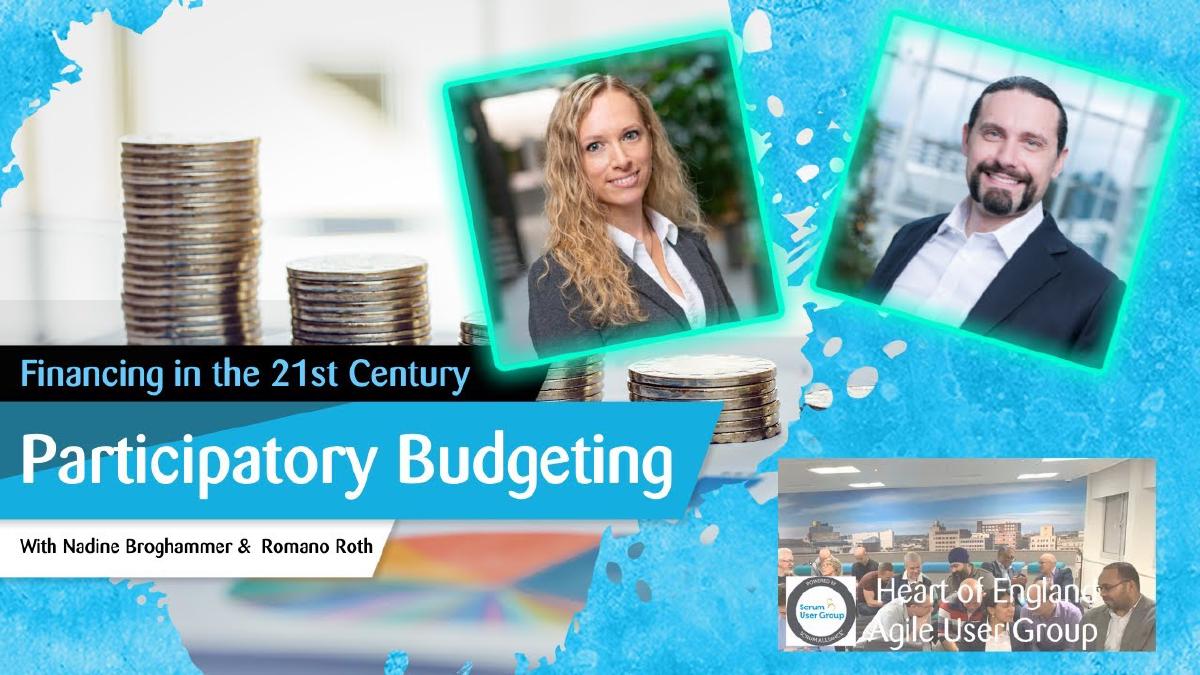
This is the English-language version of our talk on participatory budgeting at Zühlke. Nadine Broghammer and I describe how we coached a portfolio team through a participatory budgeting (PB) event based on SAFe, and how the value stream leads collectively allocated the budget for the second half of the year. A separate post covers the German version of the same talk.
What Is Participatory Budgeting?#
Participatory budgeting is a process within the Scaled Agile Framework (SAFe) that lives at the portfolio level. Instead of a committee distributing money top-down with a watering can, the people who actually run the value streams sit down together and decide where the money goes.
A portfolio represents a unit or division of the company and contains several value streams. Each value stream owns a specific solution end to end, from concept to customer. It includes everyone who contributes to the solution, all the systems they use, and the flow of information and materials. The shift is fundamental: from project funding to value stream funding, and from top-down allocation to bottom-up consensus.
Coaching the “Fruitmix” Portfolio#
In the talk, we walk through a real example from Zühlke Switzerland (anonymised as the “Fruitmix” portfolio with value streams named after fruits like Banana and Date). The portfolio management team had set a budget of CHF 100,000 for the second half of the year and wanted to allocate it across ten value streams. The first half had been turbulent because of COVID, and the team needed to invest where it would have the most impact while still keeping the lights on.
We ran a two-hour preparation workshop with the ten value stream leads to introduce the PB concept. They then had about two weeks to describe their initiatives as Epics using the SAFe epic template, split between Run-the-Business (RTB) and Grow-the-Business (GTB). Epics are anchored in a hypothesis statement (for whom, what problem, what outcome, what leading indicators), which makes it possible to validate them quickly rather than waiting for lagging indicators. As coaches we adapted the SAFe Excel template to Zühlke’s needs and prepared the agenda, breakout rooms, and calculation logic.
Running the Forum in Two Rounds#
For the event itself we split the value stream leads into two groups of five, each with a coach. Both groups always represented half of the value streams, but they made decisions for the whole portfolio.
Round 1 – Run-the-Business. Each value stream pitched its ongoing activities. Both groups independently allocated the full CHF 100,000 across all ten value streams, including those not represented at their table. Coaches kept time, surfaced the OKRs, and helped the groups stay focused on portfolio-level outcomes. In plenary the two proposals were merged into a single agreed RTB allocation.
Round 2 – Grow-the-Business. The remaining budget (CHF 100,000 minus RTB) was now visible to everyone — and it was tight. What happened next was the most striking part of the event: value stream leads voluntarily reduced their own RTB budgets to free up more space for innovation. Partnerships were proposed, joint epics emerged across value streams, and the GTB discussions became intense. Both groups proposed a GTB allocation, and the plenary worked through the differences toward a shared decision.
Outcomes and Lessons Learned#
The outcome was a budget that the value stream leads owned themselves, not one imposed on them. Transparency increased dramatically — everyone now understood why each value stream got what it got. Cross-value-stream learning was significant, and entrepreneurial thinking emerged naturally once people had real budget responsibility. Participants rated the event 3.5 out of 5 with no score below 3, which we considered a strong result for a first attempt.
A few practical lessons: do not underestimate preparation, run a simulation before the real event, work in pairs (one coach per breakout group), and consider splitting the epic pitches into a separate alignment meeting so participants have more time to absorb them.
When to Use Participatory Budgeting#
Participatory budgeting works well when you have a portfolio of value streams that is too complex for any single committee to evaluate well, when you want to move from project funding to value stream funding, and when you want to grow entrepreneurial ownership inside the organisation. It is less suited to environments where decisions must remain centralised or where value streams are not yet stable enough to take budget responsibility.
Key Takeaways#
- Participatory budgeting replaces watering-can allocation. The people closest to the work decide together where the money goes.
- Fund value streams, not projects. Combined with epic hypotheses, this directs money to validated ideas instead of fixed project plans.
- Two rounds, RTB then GTB. Showing the remaining budget after RTB makes the cost of “business as usual” visible and unlocks entrepreneurial moves.
- Transparency is the biggest benefit. Everyone sees the trade-offs, so frustration drops and buy-in goes up.
- Entrepreneurial thinking emerges naturally. When leads own the budget, they invest where the portfolio benefits most — even if that means giving up their own share.
- Preparation and facilitation make or break the event. Good templates, a simulation run, two coaches, and tight moderation are essential.
Co-author: Nadine Broghammer