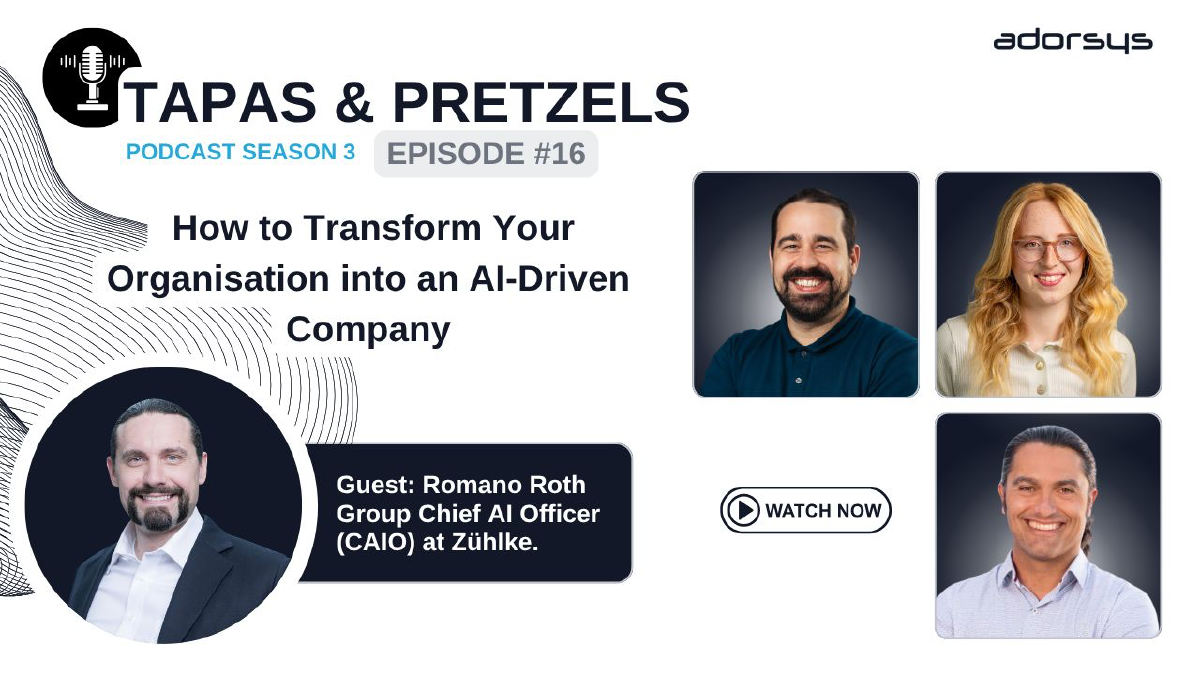
I joined the adorsys Tapas & Pretzels podcast for a conversation with co-hosts Tim and David, fellow Chief AI Officer, about the question every leader is now asking: how do you move AI from isolated experiments to a company-wide capability? We talked about token economics, what the Chief AI Officer role actually demands, why capability beats tools, the trust gap that governance exists to close, and why most companies are speeding up broken processes instead of rethinking them.
What Keeps a Chief AI Officer Awake at Night#
Right now, it is tokens. We recently started monitoring token consumption because GitHub Copilot changed its licensing model. Before, every developer had a subscription, and you could calculate the cost cleanly against the number of people you onboard or offboard. Now you pay for consumption, and the spending goes through the roof.
So we identify the employees who burn a lot of tokens, call them, and ask what project they are on and why. The interesting conversations start when someone burning a lot of tokens turns out not to be on a project at all.
The Chief AI Officer Is an Integrator#
Token spending is only the technical surface. The real difficulty of the role is that you have to talk to the CTO about technology, to risk management about risk, and to the CEO about business, all in the same week. AI systems are risky by nature because they are built on uncertainty, and you have to learn to deal with that uncertainty.
I like to describe the Chief AI Officer as an integrator and an ecosystem builder. You do not need to be the deepest expert in any single area, but you need deep knowledge across many. And you need social skills, because what you are really architecting are decisions. It is about fostering agreement between people with different accountabilities, finding the shared KPIs with real business impact. In business, if there is no shared KPI that touches the budget, collaboration simply does not happen.
AI-First Means Changing the Organisation#
At Zühlke we talk about our AI-first transformation. I am tasked by the CEO and CTO to transform the company into an AI-first organisation, and that touches everything: the organisation itself, the processes, governance, security, and the technology foundation so that everyone can actually use AI.
And it touches people most of all. Everyone needs to understand what AI really is. It is a pattern matching engine. An impressive one, but a pattern matching engine. Being AI-first means that when you have a problem, you first ask whether AI can help solve it, and if so, how. To do that, you need to understand how AI works, and you need to have experienced it yourself.
Build Capability, Do Not Just Buy Tools#
You cannot measure AI adoption by the number of tools you own. That is procurement, not adoption. What you have to build is capability, and that means a different kind of training. Not “how to use this tool or that tool,” but helping people understand what happens behind the scenes so they can ask: how can I improve my process, what value can I add with AI?
“Buying tools is easy, it is a procurement decision. Building capability takes longer, and it is a business decision with real impact on your objectives.”
This is why you have to give people time and space to experiment with their own processes. You tell someone who already does great work writing proposals or reports: now try it with AI, and let us see how it goes. That is where the unlearning and relearning happens. It is hard, it takes a lot of time, and I have to do it myself constantly.
Inspire People, Then They Follow#
Earlier this year I recorded a video showing how I use Claude Code for everything: reports, PowerPoints, answering and summarising emails, prototyping. It is still my go-to tool. That video had ripple effects across the company. Suddenly everyone ordered Claude Code and wanted to work the same way. Recently the business side recorded their own video showing how they use it to sell projects and answer RFPs.
You inspire people, and they move in that direction on their own. The contrast is sharp when you look at companies where this is not allowed, or where people can only use weaker models. There you see far more reluctance, and it is simply less fun.
The Trust Gap and the Role of Governance#
The conversation is shifting from what we can do with AI to what we can deliver in a safe and responsible way. AI capability is no longer the problem. Trust is. And that trust gap is not a technological problem, it is an organisational one. Closing it is one of the main aims of AI governance, and more and more leaders are becoming aware of how important that is.
I would even say that if you need a governance document, you have already failed a little. My vision, which I am implementing, is a single page where anyone can drop whatever they have. On the back end, an on-prem model looks at the content and decides: if it is strictly confidential, it stays on-prem; otherwise it can be delegated to a frontier model. The goal is to remove the friction of having to know the governance rules at all.
You Own Every Word#
The other side of trust is AI slop. Long, mediocre documents that you can spot instantly by the em-dashes and the generic phrasing. The moment people smell AI in someone’s work, it gets devalued, and trust in that person drops with it. Studies back this up.
When you know an LLM is a pattern matching engine, you know that what comes out is essentially the average. Better prompts, more context, and good data give you a better output, but you always have to check. This is why ownership matters so much.
“At Zühlke I always say: you own every word that comes out of an LLM.”
Architecture matters here too. A general LLM gives you the most documented answers, which are not necessarily the most relevant ones. If you want the long-tail factors to surface, you have to engineer for it, for example with clustering or retrieval. Ask the right question and you reduce hallucinations; design the architecture around your output space and the system actually serves your objective.
Fix the Process Before You Add AI#
When you ask a frontier model about architecture, you usually end up with microservices, because that is what it was trained on. The same trap exists with processes. If your process is badly designed, AI will simply reproduce your mistakes faster and multiply them. Speed amplifies everything, including risk and reputational damage.
So the first step is to analyse the process. I use good old value stream mapping: map every step from ideation to production, then measure lead time, process time, and percent complete and accurate. That shows you exactly where the bottlenecks are, and you can design a future value stream that resolves them.
Then comes the key question for each step: does it need to be 100% accurate? If the answer is yes, AI is probably the wrong tool, because reliable 100% accuracy is very hard to achieve with AI. That is automation, which is unfortunately less hyped right now. Otherwise you are just executing a worse process faster with less accuracy.
The Work-Transformation Matrix#
The CEOs of the AI companies keep saying jobs will be replaced. I do not think that is quite true. They point at a narrow task an AI can do, but the narrow task is not where the value is. Value lives in the whole value chain, across many tasks.
So I draw a simple matrix. On the horizontal axis: does the work stay the same, or does the work transform? On the vertical axis: how much do we hand to AI, and where does the human work together with AI? That gives you four fields. When companies place their tasks on it, most of them cluster on the left, where the process stays the same and we only ask whether AI can assist or take over. The real gains, the massive performance gains, come when you are willing to transform the process itself. Most companies are unwilling to do that, and that is the most interesting part to think about.
Skills for the AI Era#
What should everyone learn to be ready, not just Chief AI Officers? Critical thinking, analytical thinking, and whole-system thinking. AI systems are complex systems, ecosystems, pipelines, not just software. You have to see the input you allow in, the data you rely on, the output you deliver, and the actions you let AI take on your behalf. You have to decide where the human is in the loop or out of it, whether humans can override and roll back decisions, whether you can explain and trace them, and whether you can reconstruct what happened after an incident. That whole picture is governance in the full sense.
What Stays Underestimated in 2026#
Two things are still underestimated. The first is running AI across jurisdictions. Regulations differ enormously around the world, and you have to keep consistency across an organisation. You cannot relax the rules in one branch office and tighten them in another, which means convincing leaders to apply stricter controls where needed. That is genuinely hard.
The second is the economics. The numbers these companies are investing are staggering. There are calculations going around suggesting that for the investment to pay back, every human would need to spend something like a thousand dollars a month on subscriptions. Token prices will rise, and when they do, many startups with brilliant business cases will see those cases collapse. The same risk applies to us. We invest heavily in workforce enablement and in automating processes with AI, but when prices cross a certain threshold, a business case can turn red overnight, even for a simple task. Then you find yourself saying: we invested a lot in automating this, and now we need to hand it back to a junior. I think many will hit that wall by the end of this year.
Key Takeaways#
- Token economics is the new operational reality. Consumption-based pricing changed the game, and monitoring who burns tokens, and why, is now part of the job.
- The Chief AI Officer is an integrator. Deep knowledge across many areas, strong social skills, and shared KPIs with business impact matter more than narrow expertise.
- Build capability, do not just buy tools. Adoption is people understanding how to add value with AI, not a count of licenses.
- Trust is the real gap, and governance exists to close it. The best governance removes friction; you own every word that comes out of an LLM.
- Fix the process first. AI multiplies a bad process. Value stream mapping reveals where AI helps and where you actually need automation.
- Transform the work, not just the tooling. The big gains come from redesigning the process, which is exactly what most companies avoid.
- Watch the economics. Rising token prices can turn a sound business case red, and cross-jurisdiction regulation stays harder than most leaders expect.
- And the most important one. To become a true Chief AI Officer, black glasses and long hair are apparently mandatory. Both David and I have them, so the evidence is conclusive. ;-)
Original episode by adorsys: https://www.youtube.com/watch?v=phxwEbQyvkc