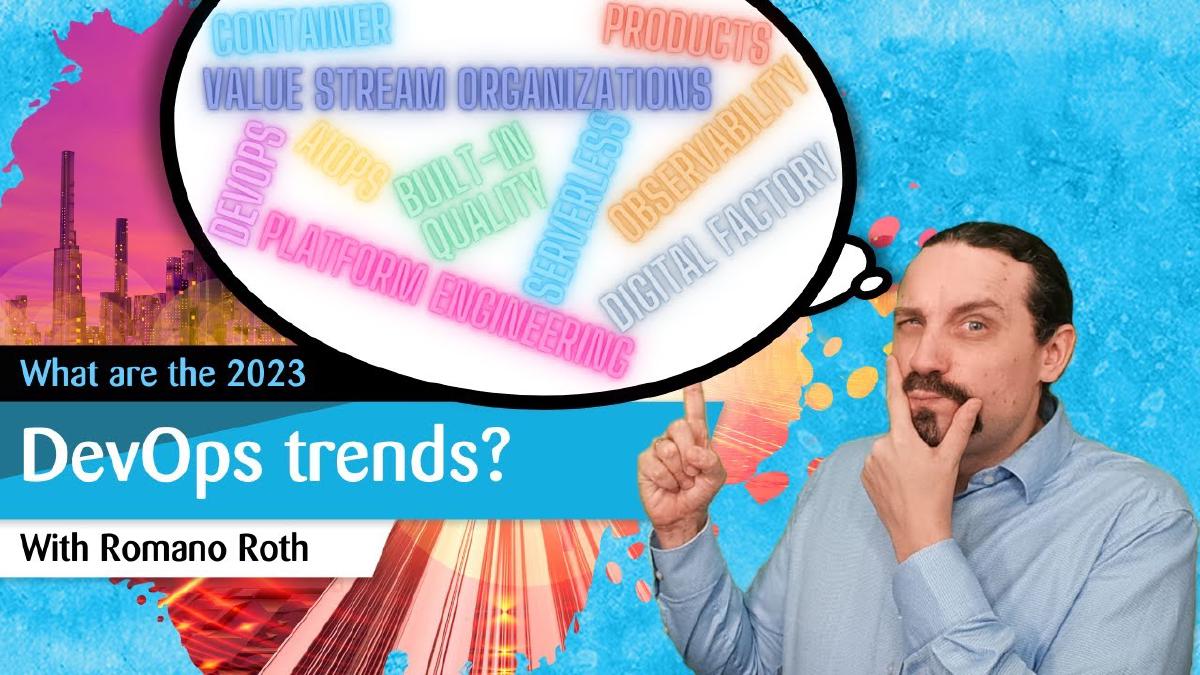
Two years of trend predictions later, the DevOps conversation has shifted. In 2021 we talked about adoption. In 2022 we mapped trends onto the adoption lifecycle. In 2023 the most useful lens is the value stream: how products get built, run, quality-assured, monitored, organised, enabled and industrialised end-to-end. Most organisations still suffer from silos and project-based annual planning. The 2023 trends are about closing those gaps.
From Projects to Products, From Silos to Streams#
Before getting to the trends, the framing matters. DevOps is a mindset and a culture with technical practices that align everyone across the value stream to continuously deliver value to the customer. As long as your organisation plans annual projects and runs siloed business units, no tool will save you. The 2023 trends only pay off in organisations that take the value stream seriously.
Building the Product#
On the build side, expect more emphasis on cloud-native architectures, containerization, infrastructure as code and trunk-based development. The new entrants are AI-assisted development — code generation, code review, test generation — and a sharper focus on developer experience as a measurable outcome.
Running the Product#
Running the product is where platform engineering takes centre stage in 2023. Internal developer platforms (IDPs) wrap the cloud, Kubernetes, CI/CD, security and observability into a paved road that product teams can self-serve. Site reliability engineering (SRE) practices — SLOs, error budgets, blameless postmortems — go mainstream. GitOps continues its march as the default operating model for Kubernetes-based systems.
Ensuring Product Quality#
Quality is no longer a phase; it is a property of the pipeline. Continuous testing, contract testing, chaos engineering and security testing all run as automated gates. DevSecOps tightens further: SBOMs (Software Bill of Materials), supply chain security, signed artifacts and policy as code. Expect regulators in finance, healthcare and the public sector to push hard on these topics in 2023.
Monitoring the Product#
Observability matures from a tooling conversation to a practice. Metrics, logs and traces feed into AIOps for anomaly detection and alert correlation. The leading teams move beyond reactive monitoring to predictive operations, using ML on production telemetry. The hard part is not the tooling; it is getting the data quality good enough to act on.
Organising Across the Value Stream#
Team Topologies has become the default vocabulary: stream-aligned teams, platform teams, enabling teams and complicated-subsystem teams. Value Stream Management (VSM) tools give leadership end-to-end visibility from idea to customer outcome. The 2023 trend is leadership stopping the pretence that a single org chart can deliver products and instead designing the team interactions explicitly.
Enabling DevOps in Product Teams#
Enabling teams help stream-aligned teams adopt new practices and technologies. In 2023 this means coaching on platform usage, on DevSecOps, on observability and on AI-assisted development. The shift is from training-as-a-class to enabling-as-a-relationship — small, embedded engagements that leave the team with new capability rather than slides.
Industrialising the Whole Product Development#
The endgame is industrialisation: standardised, repeatable, measurable end-to-end product delivery. Golden paths, paved roads, platform-as-a-product, FinOps to keep the cloud bill honest, and DORA metrics or SPACE to measure performance. Organisations that get there in 2023 will have a structural advantage over those still firefighting individual pipelines.
Key Takeaways#
Value stream is the right lens for 2023. Silos and project planning are the actual blocker. Tools alone will not fix that.
Platform engineering goes mainstream. Internal developer platforms wrap the messy underneath into a paved road that teams self-serve.
Supply chain security is non-negotiable. SBOMs, signed artifacts, policy as code. Regulators and customers will demand it.
Team Topologies is the new vocabulary. Stream-aligned, platform, enabling and complicated-subsystem teams — design the interactions explicitly.
Observability becomes a practice, not a tool. AIOps and predictive operations only work if the data is good.
Industrialise the value stream. Golden paths, FinOps, DORA / SPACE. Standardised, measurable, end-to-end delivery is the durable advantage.