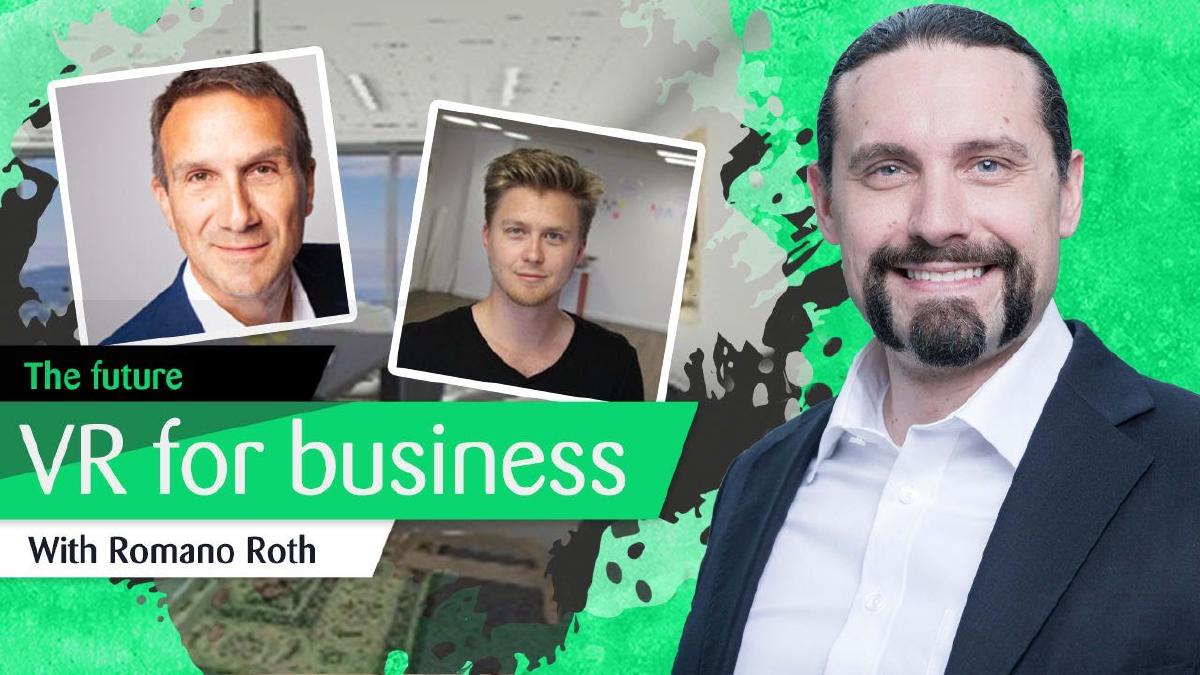
After the strong response our previous video on VR received on LinkedIn, people kept asking the same questions: Is this really the new normal? Where is the technology going? Is now the right moment to jump in? To go deeper, I invited Christoph back into the conversation together with Michaela. Christoph has been working with enterprise clients on virtual reality for years, and our discussion ranges from the maturing hardware and software ecosystem to what a workshop in VR actually feels like, and why the employer of the future will hand out three devices instead of one.
From Prototype to Real Product#
Four years ago, when Michaela and I first worked on a VR project together, the setup felt like building a home gym every time you wanted to jump in. Cables, external sensors, a dedicated three-by-three-meter space, a powerful computer in the corner. Christoph’s observation is that this world is gone.
In the last six months in particular, he sees the technology crossing an inflection point. Enterprise adoption has accelerated in a way that simply was not the case a year or a year and a half ago. What used to be a prototype is now a real product. Hardware has become user-friendly and available at scale, use cases are becoming replicable, and the software ecosystem around them is maturing. The last twelve months, in his words, were pivotal.
That matters because the friction around the technology is what always held it back. Remove that friction, and the things that already worked start working at scale, across departments and across processes.
Not a Glorified Video Conference#
One of the clearest points Christoph made is about what VR is not. It is not a better camera. It is not a better microphone. And it is emphatically not a glorified video conference where everybody puts on a headset to share a screen and stare at it together. If that is all you do, you will never justify the change management effort required to adopt the technology.
What VR actually delivers is a fundamentally different way of being together. Even a simple meeting in VR feels more intimate, more focused, and more connected than the same meeting on a video call. The sense of presence is the foundation, and every benefit stacks on top of it.
When I joined the VR meeting for this conversation, I was sitting at my desk with a coffee cup next to me. But it genuinely felt like I was sitting at a table with Christoph and Michaela, having a real conversation. The other two were physically miles away, and yet the interaction felt personal.
Where VR Shines Right Now#
The real business case today, Christoph argues, is in meetings that a video conference cannot handle well. Think of a workshop with twenty people where you actually need to make a decision. On a video call, one person speaks at a time, one piece of information is shared at a time. The dynamism of a real team in a real room is simply missing.
In VR, that dynamism returns. People split into groups. They work in parallel on whiteboards. They move around the space. They discuss complex data spread out across their field of view instead of crammed onto a small screen. Decisions that would otherwise drag across several video calls happen in a single immersive session.
For those kinds of meetings, complex decisions, strategic workshops, data-heavy discussions, the payback time on equipping people with headsets is, in his experience, incredibly fast. That is the honest business case, not a wow factor.
Compatibility and Cognitive Bandwidth#
One of the more nuanced points in the conversation was Christoph’s concept of cognitive bandwidth. A VR meeting can actually carry more information than an individual working on a laptop, because the space around you becomes usable. A presentation here, a whiteboard there, data visualizations in between. You turn your head instead of juggling tabs.
But that only works if VR does not become an island. You cannot build a productivity environment where no data flows in and no data flows out. The transition from traditional tools into VR has to be smooth, not binary. Work streams should be able to move into VR gradually, as the use cases prove themselves, without forcing the organization to choose between legacy systems and immersive collaboration.
Getting this balance right is the hard product question. How do you bring in concepts from the physical world like whiteboards, post-its, and screen sharing without limiting what VR can do? That is where good solutions distinguish themselves from gimmicks.
The Space Question#
One detail that stuck with me from our previous conversation was the cost of physical space. Companies hold real estate with large square footage, and over the past months a lot of that space simply sat empty. Good meeting rooms with whiteboards, screens, and room to move are expensive in big cities, and you end up paying for capacity you rarely use in full.
In VR, space is essentially free to replicate and reshape. You can have a small room for a focused one-on-one, a large auditorium for a company-wide announcement, or a mountain terrace with a view of a lake for a strategic offsite, and switch between them without moving anyone. The psychology of a space influences how people interact, and in VR you can choose the environment that actually fits the meeting.
The Employer of the Future#
Toward the end of our conversation, we came back to a piece Christoph and his team had written about the employer of the future. Their shorthand was SLH: smartphone, laptop, and headset. The point is not that VR replaces everything else. It does not.
You will not spend eight hours a day in a headset. You will continue to use video conferencing, chat, and email for everything they already handle well. But for a specific class of meetings, strategy, workshops, immersive team events, networking, VR becomes the right tool. The employer of the future equips people with the right instrument for the right job.
This also reshapes how we think about geography. Christoph made a point that stayed with me: in twenty years, we may look back at today as barbaric, because so many people were forced to choose between family and career, to relocate to cities purely because their jobs were anchored there. The promise of VR and spatial computing is that employers will be able to work with the people they want, wherever those people are. Work becomes more equal, not more dystopian.
What I Miss, and What VR Gives Back#
During the pandemic, what I missed most was not formal meetings. Those migrated to video conferencing without too much pain. What I missed was the coffee-machine chat with colleagues, the unplanned conversation in a hallway, the social connection that forms almost by accident. Those informal moments have been the real casualty of fully remote work.
The evening before this conversation, I attended a meetup in VR. I walked up to a table, joined a chat, and suddenly felt like I knew the people at that table. I could hear them, sense them, feel their presence. That is the part of in-person work that video calls have not been able to replicate, and it is the part VR actually restores.
This does not mean VR will replace real human contact. But for the moments where we cannot be in the same room, and for the global collaboration that is increasingly normal, it offers something closer to the real thing than any tool we have had before.
The Remaining Hurdles#
I do not want to pretend the technology is finished. The biggest hurdle I still see, and I hear this from friends and colleagues all the time, is simply the device. You need to own one, put it on, and set it up. The moment software exists that lets people join a VR meeting from a normal PC to simulate the experience, adoption will climb significantly.
The second hurdle is that we are still learning which meetings belong in VR and which do not. Every organization has to experiment to figure out where the technology adds value and where it does not. Not every use case works everywhere, and that is fine. What matters is the willingness to try.
Christoph pointed out something encouraging here. In the clients he works with, they now see clear activation moments. A first social event, a first workshop, a first strategic presentation in VR, and the conversion rate of people who then want to bring it into their own teams is very high. Once people experience it, most of the skepticism dissolves.
Riding the Wave, Not Chasing It#
My closing recommendation is simple: try it. We are at a tipping point. The growth right now looks exponential, even if from the outside it still feels like a flat curve because the market of work is so enormous. Within the next six to twelve months, I expect to see a serious increase in the number of meetings and events happening in VR.
If you are an organization and spatial computing is not yet on your map, now is the moment to put it there. Not because of hype, but because the companies adopting it are not doing so as a gimmick. They are using it to make decisions faster, work more flexibly across geographies, and build teams that are not bound by location.
As I said at the end of the conversation: smart working for the future is VR. Be brave and take the step. If you are in the first wave, you get to shape how your organization uses the technology. If you wait for the wave to pass, catching up will be harder.
Key Takeaways#
VR has crossed an inflection point. In the last twelve months, the technology moved from prototype to real product. Hardware is user-friendly, use cases are replicable, and the software ecosystem has matured.
Do not build a glorified video conference. VR’s value is the sense of presence and the ability to collaborate dynamically. If your VR solution just mirrors a screen share, it will not justify the adoption effort.
Start with the meetings where VR shines. Complex decisions, strategic workshops, data-heavy discussions, and team events are where the payback is fast. Not every meeting needs to move into VR.
Plan for integration, not an island. Work streams should be able to transition into VR gradually. Data needs to flow in and out. Treat the transition as continuous, not binary.
Think of the employer of the future as SLH. Smartphone, laptop, headset. Pick the right tool for the right interaction instead of forcing everything into one channel.
Lower the experience barrier. Organize a first VR event for your team, even a small one. The activation moment, once people have actually felt presence in VR, drives far higher adoption than any pitch.
Do not miss the train. Exponential growth looks flat from the outside at first. The organizations informing themselves now and running their first pilots will be years ahead of those who wait.