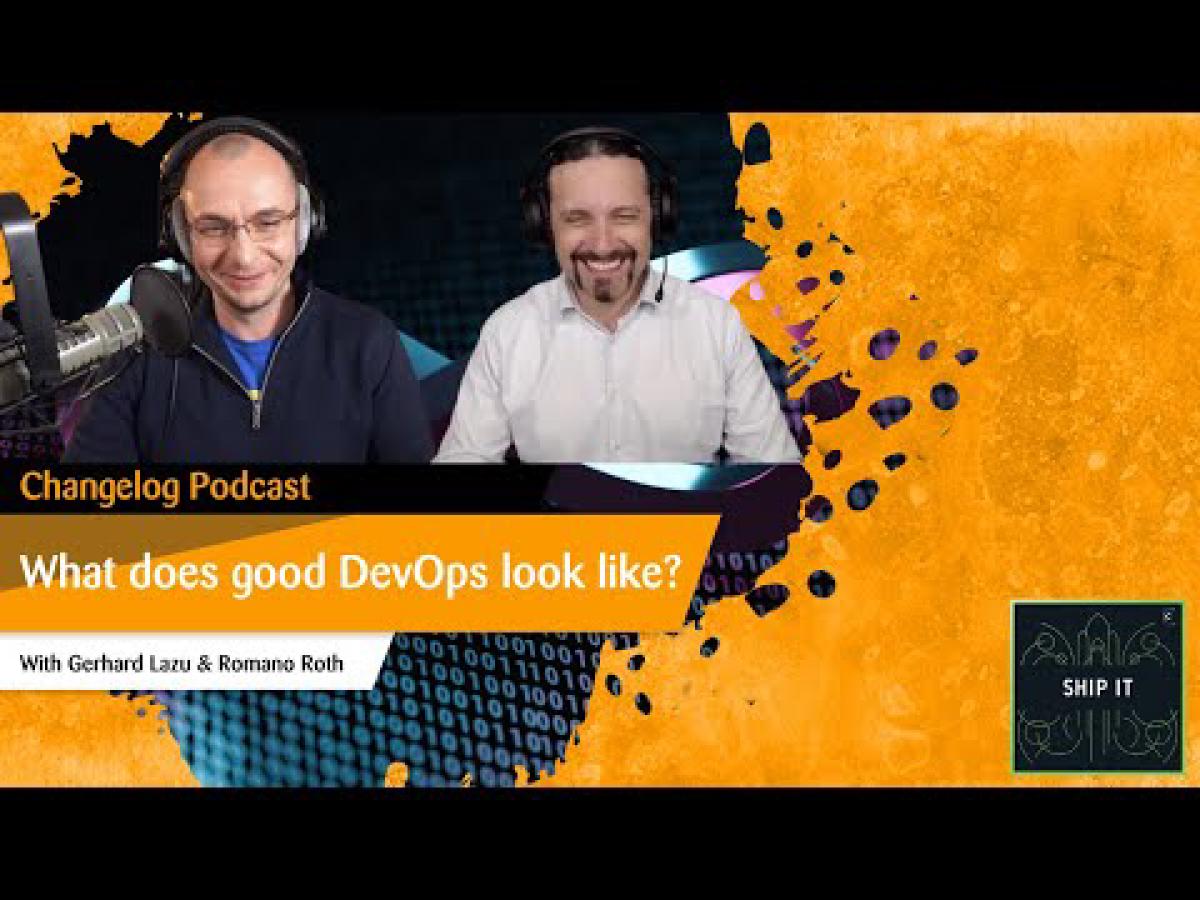
In this episode of the Ship It podcast, Gerhard Lazu and I have a deep conversation about what good DevOps looks like in practice. We talk about the real challenges companies face during transformations, how to deal with middle management resistance, technology choices, and where the industry is heading with AIOps and hyper automation.
My Journey into DevOps#
When I started my career in 2002 as a .NET developer at Zühlke, I was always curious about how to ensure the quality of what I was building. I was a bit lazy and wanted to automate things. So I moved into continuous integration and continuous deployment. As applications grew bigger and more distributed, I became an architect and shifted toward building continuous delivery pipelines. When the DevOps movement started, I jumped on it because continuously delivering value to the customer has always been at the heart of what I do.
Today, as Head of DevOps at Zühlke, I lead a team of about 31 DevOps engineers and consultants, working with different customers across various industries on IT and DevOps transformations.
What Good DevOps Looks Like in Practice#
One of the best examples I shared was from a customer where we built an agile release train for their transformation. We had different teams focusing on governance, CI/CD pipelines, and containerization. The key learning came from how we handled delivery.
In the first sprints, we delivered to the customer, but the customer was not using what we delivered. So we changed the approach: the customer needed to actively take over and use what we built. We put it in the definition of done. But that was still not enough. So we went one step further: in our review meetings, our team no longer demonstrated the work. The customer had to demonstrate how they were using it.
“Don’t just deliver to the customer. Let the customer show what you have delivered and how they are using it.”
This simple shift made a massive difference in adoption and value delivery.
The Biggest Obstacle: Middle Management#
When Gerhard asked about the biggest obstacles to DevOps transformations, I was direct: it is the middle management. In many companies, there are units organized as silos, each with a head who has built that unit and chases specific goals. When you start an agile or DevOps transformation, you align people around the value stream and bring them together. Some of these leaders see that they are losing power, and they resist.
The solution starts at the top. The top management needs a clear vision and clear guidance. They need to change the goals of middle management. Only by changing goals can you change behavior. And if someone truly does not want to change? Then potentially that person needs to leave the company. It is a difficult but sometimes necessary conversation.
Ship Less, More Often#
The core of good DevOps comes down to a simple principle: ship less, more often, and check if it works.
Behind every business idea is a hypothesis. You need to identify this hypothesis and figure out the minimal thing you need to do to prove it. This is where you define your minimum viable product and your leading indicators. By doing this, you reduce batch sizes massively, and the work flowing through your value stream becomes focused and meaningful.
You don’t need to chase Google, Netflix, or Amazon. It can be perfectly fine to ship every day or every week. The point is to find the sweet spot for your context. Any code or feature that is built but not out there is inventory, and zero inventory is the best type of inventory.
“Don’t be afraid to take decisions. Don’t be afraid to make a bad decision. Just constantly learn and react and constantly adapt.”
Technology Decisions Belong to the Team#
When it comes to choosing technology, I believe the team that needs to work with a technology should make the decision. If someone else decides, the team does not stand behind it. My approach is to first understand the real need: what problem are we trying to solve? Then evaluate different options with a structured analysis, build prototypes to get hands dirty, and let the team decide.
The story I shared about switching from server-side rendering to Angular illustrates this well. We started with an old technology to move fast, learned what the customer really needed, hit the limits of the technology, and then made the tough decision to switch. It felt like a failure at the time, but it was the right call. The initial approach enabled us to learn quickly, and the sunk cost should never prevent you from making the correct decision.
AIOps and the DevOps Trends#
We discussed the growing role of AI in operations. I use tools like Dynatrace and Datadog, which leverage AI for pattern matching across distributed log files. At one client, we had been chasing performance problems for a long time. By using Dynatrace, it pinpointed the exact server with a configuration problem in minutes. That is the power of AIOps.
Looking at the trends, I see three major directions:
- Hyper automation: Going beyond simple automation to automating nearly everything in the delivery pipeline
- Cyber resilience: Combining DevSecOps with broader organizational resilience against attacks
- Observability: As automation increases, so does the data you need to monitor and understand
Participatory Budgeting#
One topic close to my heart is participatory budgeting. The traditional approach, where someone at the top divides the budget equally, is inefficient because budget holders often do not understand the true impact of each initiative.
In participatory budgeting, all value stream members come together, receive a budget pot, and pitch for their initiatives. They discuss impact, alignment with strategy, and value creation. This sparks entrepreneurial thinking and emotional ownership, resulting in better budget allocation that truly supports the company’s goals.
Key Takeaways#
- Deliver value, not just features. Have customers demonstrate what you delivered and how they use it.
- Address middle management resistance head-on. Change their goals from the top to change their behavior.
- Ship less, more often. Identify hypotheses, reduce batch sizes, and validate early.
- Let teams choose their technology. They own it, they should decide it.
- Leverage AIOps. AI-powered observability tools can find problems in minutes that would take weeks manually.
- Invest in participatory budgeting. It aligns investment with strategy and creates ownership across the organization.