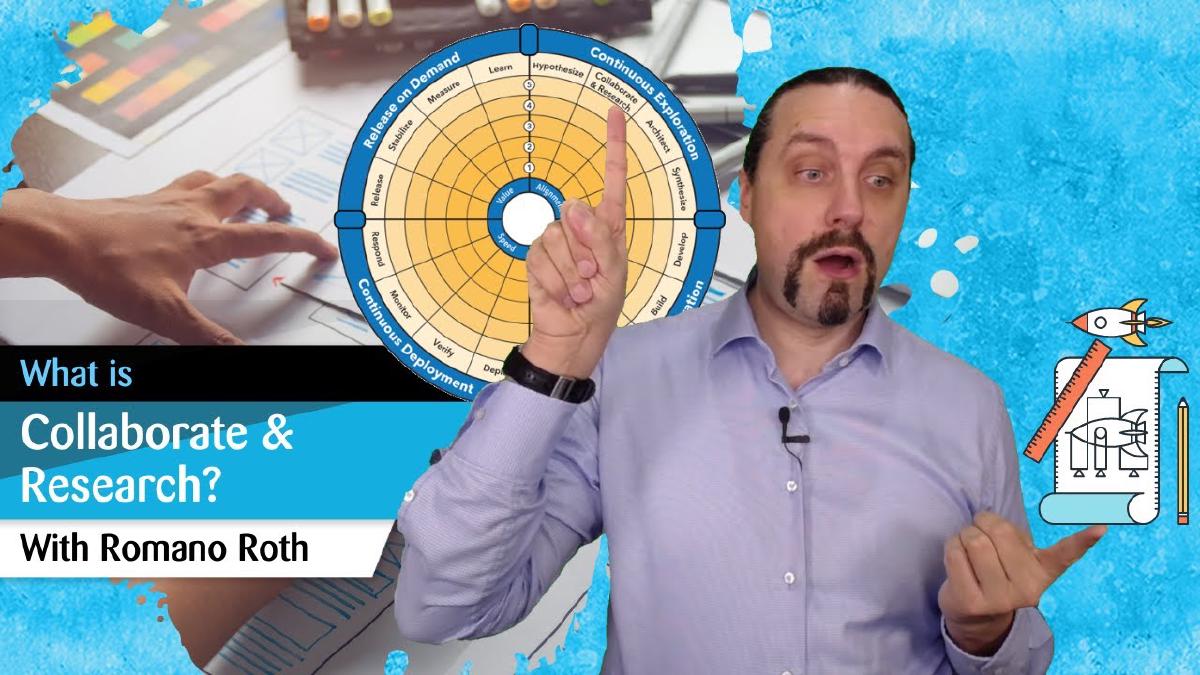
Collaborate & Research is the second step in the SAFe DevOps Health Radar. In this video, I explain how teams collaborate internally and conduct market research to define a minimal feature set that validates the hypothesis from the previous step.
Why Collaborate & Research?#
The fundamental question behind this step is simple: do you know whether your idea or hypothesis actually solves a real customer need? How do you know? And what is the fastest way to validate that hypothesis? Collaborate & Research exists to answer these questions before investing significant effort into building something that may not deliver value.
The Lean UX Process#
Collaborate & Research follows the Lean UX process. Starting from the epic and its hypothesis statement (created in the Hypothesize step), we identify the feature that can validate this hypothesis. From that feature, we derive a benefit hypothesis. Together with UX experts, we then create a collaborative design for this feature and build an MMF (Minimal Marketable Feature). The MMF is the smallest possible increment that allows us to evaluate the benefit hypothesis while already delivering customer value.
Researching Customer Needs#
Understanding what customers actually need is central to this step. We use several techniques to build that understanding:
- Personas: We create detailed representations of our target audiences. Each persona gets a name, a photo, skills, fears, and a thorough description so that everyone on the team shares the same view of the target audience.
- Customer Journey Maps: These maps show the end-to-end process a customer goes through when using our product. They reveal the ups and downs, the touchpoints, and the interactions with our product across all stages.
- Customer Interviews: We visit real customers and conduct interviews to identify their needs and the problems we need to solve together with them.
- Surveys and Market Research: We create surveys and research the broader market to identify market needs beyond individual customer feedback.
The Business Model Canvas#
Once we have identified the customer needs, we can create or update the Business Model Canvas (a tool by Strategyzer). The canvas helps us define:
- The value proposition we bring to our customers
- The customer segments we serve
- The channels through which we communicate with our customers
- The key activities required to deliver value
- The resources needed
- The cost structure of our business model
The Value Proposition Canvas#
As part of the Business Model Canvas, we also work on the Value Proposition Canvas. On the customer side, we document the customer’s jobs, gains, and pains. On the product side, we identify our products and services, the gain creators, and the pain relievers. This gives us a very clear picture of what value we deliver and how our solution addresses the customer’s actual problems.
What Collaborate & Research Produces#
After completing this step, we have:
- Identified customer needs and the problems we want to solve
- Style guides that can be used in subsequent process steps
- Logos and UI assets for the solution
- Prototypes or mockups that visualize the solution
- Personas and customer journey maps that document our understanding of the target audience
The Maturity Levels#
The SAFe DevOps Health Radar includes a maturity assessment for Collaborate & Research. You rate your team’s ability to collaborate with customer experts and IT experts to define a Minimal Marketable Feature in support of the hypothesis:
- Sit: Product management roles and responsibilities are not defined or followed.
- Crawl: Product management creates requirements in large batches with little customer or development collaboration.
- Walk: Product management collaborates with business side and development side experts, but not both when defining requirements.
- Run: Product management regularly collaborates with business side, development side, and operation side experts but does not define a Minimal Marketable Feature.
- Fly: Product management always collaborates with business side, development side, and operation side experts and defines Minimal Marketable Features.
Key Takeaways#
- Validate before you build. Collaborate & Research ensures your hypothesis actually addresses a real customer need before you invest in development.
- Apply the Lean UX process. Move from epic to feature to benefit hypothesis to collaborative design to MMF. Each step sharpens your understanding.
- Create personas and journey maps. These tools give the entire team a shared understanding of who your customers are and how they interact with your product.
- Use the Business Model Canvas. It provides a structured view of your value proposition, customer segments, channels, activities, resources, and cost structure.
- Build the smallest thing that delivers value. The Minimal Marketable Feature is the fastest way to validate your hypothesis while already providing something useful to the customer.
- Strive for continuous collaboration. The highest maturity level requires product management to always work with business, development, and operations experts together.