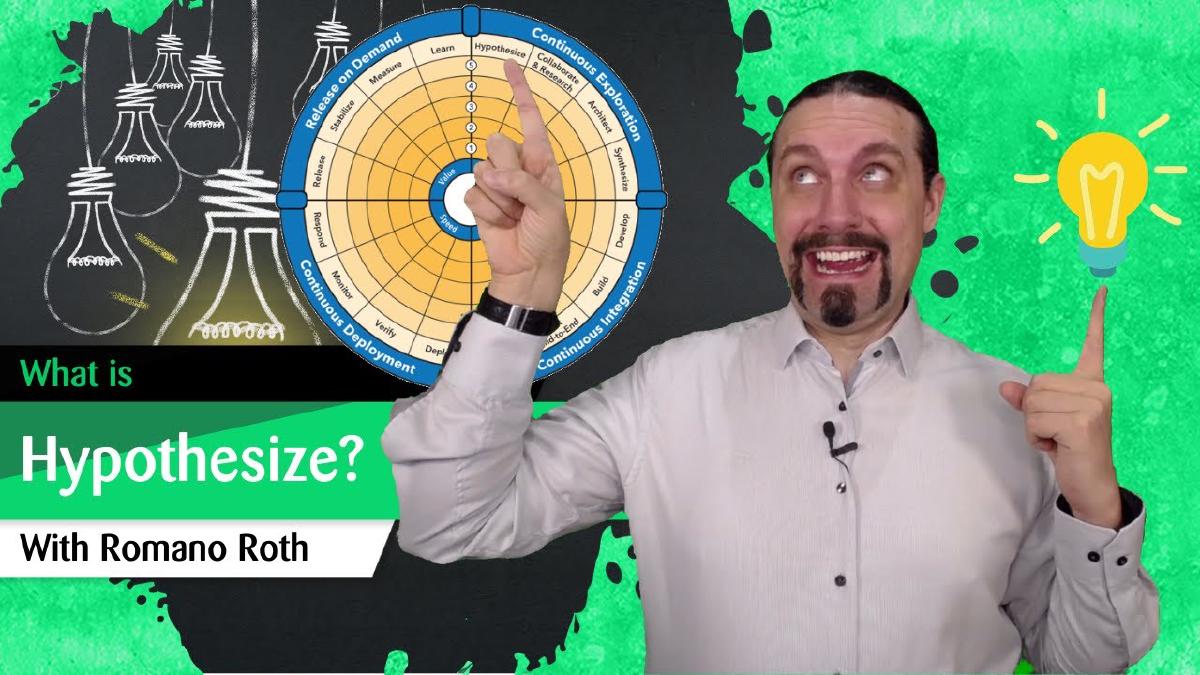
In this video, I take a deep dive into Hypothesize, the first process step of the SAFe DevOps Health Radar and the continuous delivery pipeline. The core question is simple: how do you know you are building the right thing?
The SAFe DevOps Health Radar as a Process#
The SAFe DevOps Health Radar is not just an assessment tool. It is also a process that starts with the customer and ends with the customer. The process covers the four dimensions of the continuous delivery pipeline: continuous exploration, continuous integration, continuous deployment, and release on demand. Hypothesize is the very first step in this pipeline.
Why Epics, Not Projects#
A central concept in the Hypothesize step is the epic. An epic is different from a project in a fundamental way:
- Epic: A container for a significant initiative. You define a hypothesis behind it and then build an MVP to validate that hypothesis.
- Project: Has a clear start and end, a fixed budget, a timeline, and a defined set of requirements or tasks.
The problem with projects is that they assume you already know what to build. Epics, on the other hand, acknowledge uncertainty and provide a mechanism to test whether an idea actually delivers value before committing to a full implementation.
The Epic Hypothesis Statement#
To define an epic properly, you create an Epic Hypothesis Statement. This document describes:
- The customer: Who are you building this for? (Internal or external customers)
- The problem: What does the customer want to do?
- The solution: What are you going to build?
- The business outcome: What do you really want to achieve?
- The leading indicators: How will you measure success early?
- The non-functional requirements: What constraints apply?
Creating this statement takes roughly one to two hours. It forces the team to think clearly about what they are trying to achieve before writing a single line of code.
The Lean Business Case#
After the Epic Hypothesis Statement, the next step is a Lean Business Case. This is a two-page document that defines:
- What the MVP is and what the full solution might look like
- What the MVP will cost and what the full implementation will cost
Creating the Lean Business Case takes roughly two to four hours. It provides just enough information to make a good investment decision without months of upfront planning.
The Lean Startup Cycle#
With the MVP defined, teams enter the Lean Startup Cycle:
- Build the MVP
- Evaluate the hypothesis using the leading indicators
- Decide: If the hypothesis is proven, invest more and build additional features. If it is disproven, pivot. That means either stopping completely or creating a new epic with a new hypothesis and going through the cycle again.
Leading Indicators and Vanity Metrics#
Leading indicators are metrics that measure early whether you are building the right thing and whether it has the desired impact. They need to be measurable quickly, not in six months or a year.
Be careful with vanity metrics. These are metrics that look impressive but do not truly measure the real business outcome. Examples include number of downloads or number of users. These numbers can go up while the actual business value remains flat. Vanity metrics can also shift from context to context, so always evaluate what a metric truly tells you.
The Maturity Levels#
The SAFe DevOps Health Radar provides a self-assessment for Hypothesize with five maturity levels:
- Sit: Ideas are only vague and not defined.
- Crawl: Ideas are defined (for example as an epic) but do not include a hypothesis statement.
- Walk: Some ideas are expressed as hypothesis statements with measurable outcomes.
- Run: Most ideas are expressed as hypothesis statements with measurable outcomes and include MVPs.
- Fly: All ideas are expressed as hypothesis statements with measurable outcomes and include MVPs.
Key Takeaways#
- Validate before you build. The purpose of Hypothesize is to ensure you are building the right thing by defining and testing a hypothesis before committing resources.
- Use epics, not projects. Epics embrace uncertainty and let you validate ideas through MVPs. Projects assume you already know the answer.
- The Epic Hypothesis Statement is quick to create. In one to two hours, you define the customer, problem, solution, business outcome, and leading indicators.
- Leading indicators measure early success. They tell you quickly whether your hypothesis holds, so you can invest or pivot without wasting months.
- Watch out for vanity metrics. Metrics like download numbers can look good without reflecting actual business value. Always check what a metric truly measures.
- Maturity ranges from Sit to Fly. Teams can assess themselves and set a clear target for how rigorously they want to validate ideas.