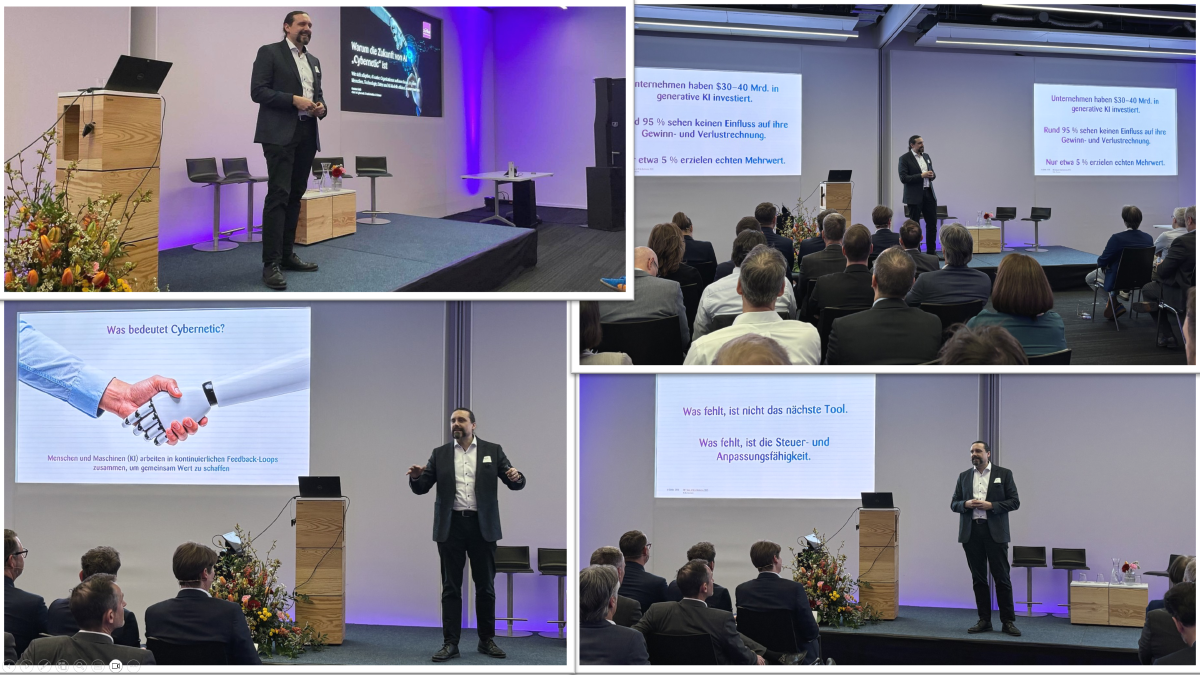
Banks spend 93% of their AI budget on technology. Only 7% goes to people. And then they wonder why 95% see no impact on their P&L.
On March 31, 2026, I gave a keynote at the Zühlke Banking Talk in Schlieren on why the future of AI is “cybernetic” and what it takes to become an AI-native bank. The evening brought together perspectives from academia, a major German bank, and practitioners from Swiss financial institutions.
The Event#
The Zühlke Banking Talk was hosted by Fabian Braunwalder (MD Banking CH, Zühlke) and Björn Lehnhardt (MD FSI Germany, Zühlke). The program featured three keynotes and a panel discussion:
- Prof. Dr. Andreas Dietrich (HSLU): “Auf dem Weg zur AI-native Bank” on how Swiss banks position themselves in a fast-moving market
- Stephan A. Paxmann (CIO, LBBW): “Agentic AI in Financial Services” on how agentic AI will reshape banking
- Romano Roth (Zühlke): “Warum die Zukunft von AI ‘cybernetic’ ist” on building adaptive, AI-native organizations
- Panel discussion moderated by Andrea Perl (Partner Data & AI, Zühlke) with Lisa Zimmermann (PostFinance), Christophe Makni (Migros Bank), and Stephan A. Paxmann (LBBW)
The Problem Is Not the Next Tool#
$30 to 40 billion invested in generative AI globally. Most companies bought tools, ran trainings, and hoped for the best. That is not a strategy. That is a shopping list.
What is missing is not the next tool. What is missing is the ability to steer and adapt.
A Cybernetic Enterprise works differently. Humans and AI work in continuous feedback loops, creating value together. Three dimensions, one system: organization, technology, and processes.
Three Theses for the AI-Native Bank#
1. E-banking dies. Agents work directly on the data. No app, no interface. APIs and structured data are the new infrastructure.
2. Who does not own the agent becomes a supplier. Context beats control. Think of the hotel behind Booking.com.
3. Your data is more valuable than your products. Mortgages, accounts, credit cards are all interchangeable. Your 156 customer touchpoints per year are not.
Regulation Is Not a Brake#
Regulation is banks’ only moat against Big Tech. Big Tech has unlimited compute and generic algorithms. Banks have decades of trust, regulated access to financial data, and governance. That is the real competitive advantage.
Human-AI Work Distribution#
The question is not whether AI replaces humans. The question is how work gets distributed between humans and AI. I presented a framework with four quadrants and real examples from the banking industry:
- HSBC: AML monitoring with 60% fewer false positives
- Lloyds/Experian: Perpetual KYC, no more periodic reviews
- Julius Bär/Unique.ai: AI investment copilot, FINMA-compliant
- Kyriba: AI liquidity manager, from “managing cash” to “steering scenarios”
The Future Organization#
The future organization has teams of 3 +/- 2 people, each orchestrating 4+ AI agents. No business/IT split. Full ownership over the value stream. A platform team serves as the AI enablement layer: agent registry, guardrails, observability, A2A.
Stephan A. Paxmann from LBBW put it perfectly: “We don’t govern code. We govern agents. We assign them IDs, budgets, wallets, just as we would with an employee.”
Insights from the Panel#
Prof. Dr. Andreas Dietrich from HSLU raised the real question: What happens to banks’ advisory services when customers trust their personal AI bot more than their banker?
The panel brought together three very different banks (PostFinance, Migros Bank, LBBW) with diverse perspectives but a shared conviction: this is not about technology alone. The discussion on governance and where to draw the line between human and AI decisions was one of the most honest I have seen.
Three Things You Can Do Tomorrow#
- Shift your budget. Cancel the next tool license. Invest the money in AI enablement for your team.
- Redesign a value stream. Business and IT together. Small. Measurable. With a feedback loop.
- Map your human-AI work distribution. Where do you delegate work? Where do you collaborate? The answer determines your roadmap.
The bank of tomorrow is not a tech company with a banking license. It is a cybernetic bank that understands its customers better than any Silicon Valley algorithm.
AI will not be the last technology wave. After AI comes the next one. And the one after that. But if your organization has the ability to continuously adapt, it does not matter what comes next. You will be ready.