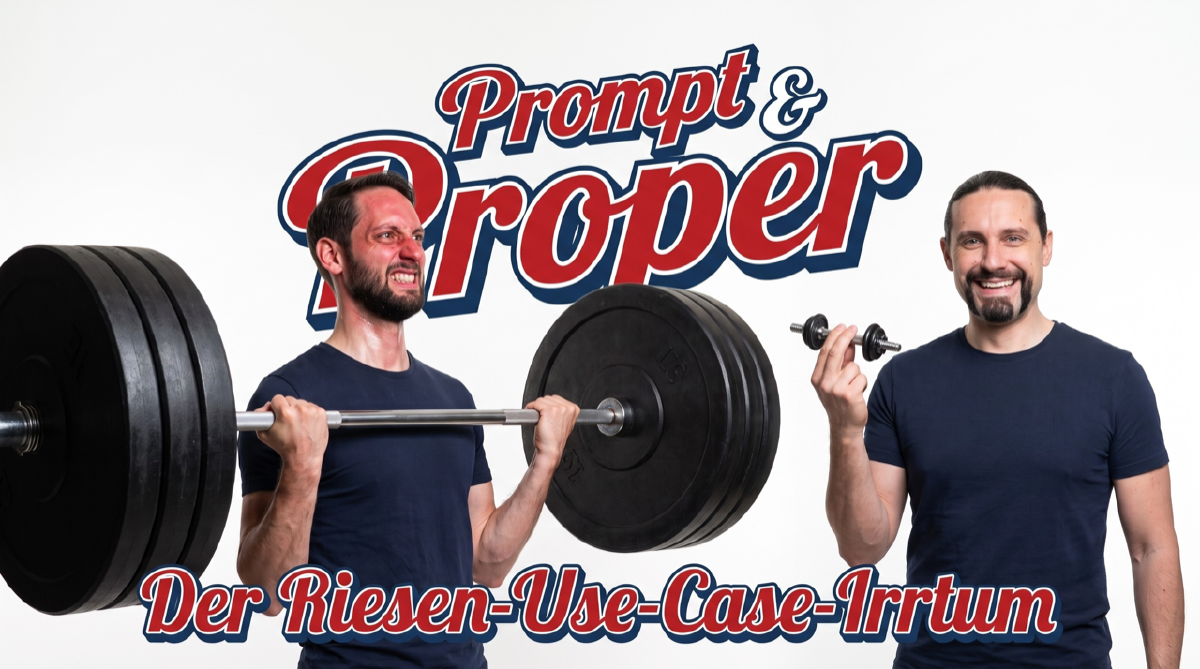
Most AI projects do not fail on the technology. They fail earlier, on a thinking error: the hunt for one giant use case, the lighthouse project.
This is the launch of my new podcast Prompt & Proper, which I host together with Steffen Ochsenreither from Swiss Post. Every two weeks, in German, hands-on and without the marketing speak. Episode 1 takes apart what we call the “giant use-case fallacy”: why the management signal “we are doing AI now” so often ends in nothing, and what a good first use case actually needs. The episode is in German, and this post captures the core of the conversation.
The Thinking Error: Going Too Big Too Soon#
The pattern shows up in small companies and large ones alike. The AI hype has been running for more than two years, and everyone wants to transform the entire business model at once. Management decides “we are doing AI now,” and for Steffen that sets off alarm bells. From that point on, months go by with stakeholder analysis, scoping, risk management, and financial calculation, all before anyone has settled what problem is even being solved. The project is designed to be huge, and often it never starts.
First the Requirement, Then Start Small#
My counter-model is simple. Define the requirement cleanly first. Then strip away everything you do not need until only that one requirement is left. And then build it first without automation. Only once the whole thing runs and delivers real value do you automate and scale.
A vision is allowed to be big, I have no problem with that. The first step is not. Companies that are still early with automation, digitalization, and AI do much better with a small start. Steffen puts it plainly: no project succeeds without a purpose.
Three Transformations at Once#
One thing keeps catching my eye. Many companies had the digital transformation, then the agile transformation, and now the AI transformation lands on top. Plenty have not digitalized cleanly and are not yet agile, and still everything is supposed to happen at the same time. For most organizations that is simply too much.
Small projects are no disadvantage here. They move fast, often deliver a much earlier ROI, and carry the organization with them. When a small, repetitive routine disappears from daily work, say a report generated a hundred times a year, you feel the impact right away.
Question the Process, Do Not Just Digitalize It#
Before you support a process with AI or digitalize it, one question comes first: does this process still make sense at all? Often you carry forward routines that were set up twenty or five years ago, and when you look closely you notice they no longer make sense as they stand. Sometimes AI creates an entirely new process. And sometimes a whole process just disappears, because a tool already solves it. You call an API, and the work is gone, with no AI at all.
The Biggest Bottleneck Is the Organization#
Technology is not the problem today. It is here and it works. Which model or tool you pick barely matters. What really counts is process and organization. That is the biggest lever.
Many companies learn this the hard way. They build use cases with no real value, sometimes even pay more because they burn more tokens, and only then start thinking about the organization. The strongest lever is to organize along the value stream. When you put accountability and P&L into a team that is fully responsible, the whole upstream chain of process falls away, meetings included. Decision-making power belongs where the information sits and where the work happens. When speed matters, that is decisive.
The nice side effect: when you build the small use case together with the team, you have the people on your side. “We have this one concrete problem, let us solve it” is a very different thing from a lighthouse project handed down from above. Steffen’s line on this has stayed with me:
“Small things are easy to do, but just as easy not to do.”
Criteria for a Good First Use Case#
Three clear criteria come out of the conversation:
- A clear purpose. What do you want to achieve, and what is the hypothesis behind it? If it holds, you scale. If not, it is disproven and you stop.
- Live in weeks, not months. The use case has to be small enough to ship in weeks. Speed matters.
- No harm if it fails. No regulatory risk, no disappointed customers. Say from the start: if it does not work, we drop it. What stays is a learning, and learning matters more today than the perfect process you spend months building.
Fast Feedback Over Long Sprints, Tools Come Last#
I am no longer a great fan of two or three week sprints. At this pace I want one-week feedback cycles instead. No heavy ceremonies, just what actually moves you closer to the goal.
And the tool question belongs at the end. Google, Anthropic, or OpenAI is the wrong first question. A tool is only as good as its purpose. Without a purpose you do not need a tool. Most things can be done with any of the big tools anyway. Buying a license is easy. Working out which process really creates value, and then making the hard decisions, is the actual work.
As a Consultant: Lay the Minimal Path Next to the Wish Roadmap#
Steffen asks how I handle it when a client shows up with a finished lighthouse concept. What I do not do is play head-on against the resistance. There is a lot of thinking behind that plan, and the intent to make money. I take the problem apart, look for the hypothesis behind it, and ask how it can be validated.
Then I put several paths on the table. One is the roadmap the way the client wants it. Next to it a medium path and a minimal path, where we ask: what is the smallest thing that validates this hypothesis in days or weeks? We follow the wish roadmap, but we set milestones and decision points where we come back with real findings and can pivot, adjust, or stop. You still need the North Star, the vision someone holds. You just break it down so you reach visible wins fast.
The Take-Away#
Do not look for the grand slam. Look for the small, real problem. A good first use case solves something you can feel, goes live in weeks, and does no harm if it fails. Because people believe in AI once they feel it and use it. That is what builds trust, and that trust is the currency that makes the big projects possible later.
If you enjoy the episode, subscribe to Prompt & Proper on Spotify, Apple Podcasts, Amazon Music or YouTube and tell us which AI topic you are wrestling with right now. It might well become our next episode.