When people talk about AI and jobs, they almost always mean developers. The larger part of the working world sits elsewhere, in offices, in HR, in marketing, in administration.
In episode 3 of Prompt & Proper, Steffen Ochsenreither from Swiss Post and I look exactly there. And we quickly land on a point that has nothing to do with technology. The episode is in German, and this post captures the core of the conversation.
Office Jobs With Repetitive Tasks Are the Obvious Case#
Steffen’s framing: jobs with many repetitive tasks that create no direct value have always been prime candidates for automation. That has nothing to do with AI. What changed is the barrier. You used to need an expert and modelled it in UiPath. Today you tell an agent.
His example exists in every company. A shared inbox, the first person in the morning sees the request, handles it, but leaves the mail unread so the second person in the afternoon notices something happened, checks it, and files the mail in a folder. Routines like this are everywhere. They could be fully automated, with a better result, shorter cycle time and fewer errors.
Requirement First, Automation Last#
My objection is the same as in episode 1. We jump to automation too fast and underestimate the complexity we take on. Every automation has to be maintained.
So: identify the requirement first. Then strip it down until only the smallest automatable piece is left. Then start the classic way, without automation. And only once you genuinely see the payoff do you automate. Last, and only the minimum. What I see a lot right now is the opposite: a complex process, AI on top, it will sort itself out.
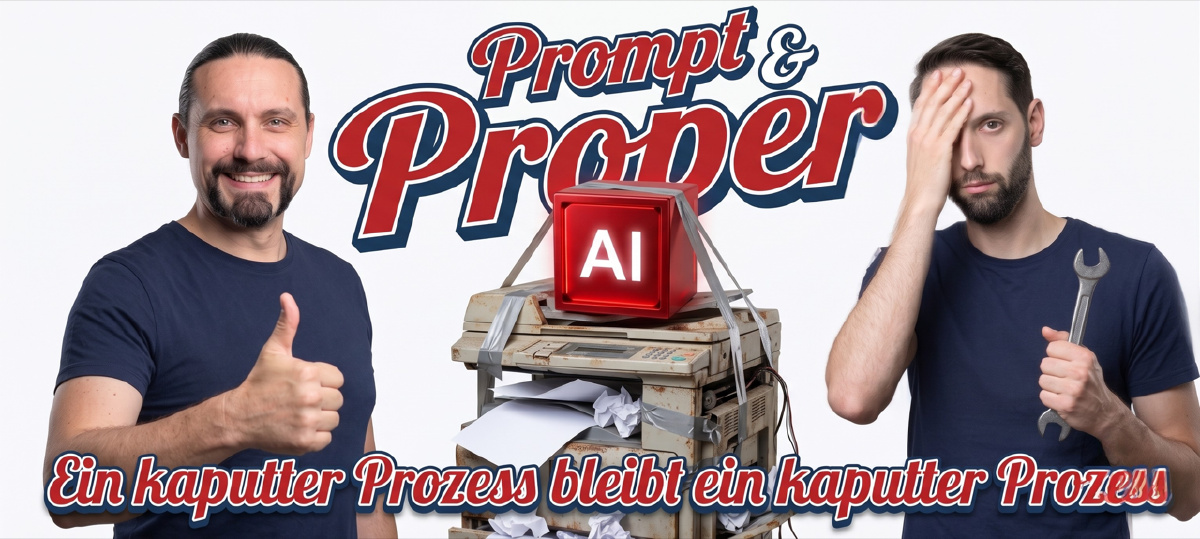
Steffen’s line on this is the core of the episode:
“A broken process stays a broken process, no matter how intelligent I make it afterwards.”
Though he immediately weighs it up: sometimes tackling the process at the root costs more than automating just the final step. The danger is the path of least resistance. You optimize the surface and leave everything behind it untouched, because that is the complicated part.
A Cautionary Example#
I was recently at a congress of the VDMA, the German mechanical engineering association. One company there had done exactly what I recommend: built an AI platform with a partner and enabled the whole workforce.
Then a customer came back to the CEO asking what kind of proposal he had been sent. The thing was full of em-dashes, nothing fit together, not even the numbers were right. Sales had produced it with AI.
The lesson is training. Handing people a tool is not enough. Add a human in the loop and a clear answer to the question of who is accountable. The managing director restated that to the workforce afterwards in no uncertain terms: the AI is not accountable. Steffen is blunt here. Letting customer-facing AI run unattended is courageous at best.
The Gap Between Potential and Usage#
One statistic Steffen brought is particularly telling: the theoretical AI coverage per occupational group against actual usage. In hands-on, production-near work both are low, which makes sense. In management, legal and the office and admin areas, theoretical coverage sits at 60 to 80 percent, in places up to 90. Not replaced, but performable with AI support. Actual usage for most of them stays below 30 percent.
The models are not the reason. The release cadence has never been this high. Two years ago there were 60 to 70 days between major releases, today an update lands almost daily. And the improvements show up mainly on complex tasks, while the simple ones have been running reliably for months.
The Real Crux: Who Owns the Process?#
I recently wanted to introduce a new AI tool at Zühlke. There is a process for that. Create a ticket, the ticket gets assigned to a person, that person sends you a Word document to fill in. My Claude filled it in, I sent it back, and what came back was an AI-generated reply.
I picked up the phone. Within two minutes we agreed that this process no longer makes sense the way it stands and that an agent would be the better answer. Except: who owns this process? Are we allowed to change it? That is exactly where we are.
I see the same thing in most organizations. Processes grew, we have always done it this way, and ownership is unclear. Steffen has a firm view on that:
“Historically grown processes are, to me, a euphemism for a chaos process.”
His picture: someone set it up at some point, it has since lived on into its sixth generation, everyone bolted something on, and none of the originals are still around. No description exists. The maximum documentation is the old hand showing the new hire during onboarding. And nobody sits down for an hour to map it, because they would then discover an owner is missing.
For me that is the key. These are value streams, and you have to map them cleanly.
Where the Impact Sits Outside Engineering#
HR. Performance reviews, onboarding, offboarding, recruiting. Many companies are already at it.
Marketing. Massively impacted. Documents and graphics come out of AI. At a conference an industrial company presented how it threw out the whole tool zoo and went all in on Google. When a new product comes, AI generates the marketing imagery to match the target market and its cultural context. Where you used to need teams, sometimes across several locations.
Steffen hooked in an important point that I had first told as a tooling success: the company mainly changed the process and streamlined everything. That Google happens to have a suite where it all interlocks was luck. A tool does not automatically bring a process change with it.
My hypothesis for industry: headcount stays the same, but generates more revenue and more margin. That is likely to be the KPI where the productivity gain becomes visible.
The Insider Tip for Job Applications#
Most applications arriving at Swiss Post are AI-generated or AI-assisted. Quality is often better, occasionally over the top. Steffen spots it by the fake dialectic, that construction where a statement is first negated before the actual claim arrives.
At the same time AI runs on the other side, in screening. And this is where it gets interesting: a cover letter written with ChatGPT gets through a recruiting tool that uses ChatGPT with markedly higher probability than one written with Claude. Steffen puts the difference between 30 and 70 percent.
That does not surprise me. LLMs are pattern matching engines. If the token space of your application matches what the evaluating network knows, you get a stronger resonance. So for anyone applying right now: find out which AI tool the target company runs in HR, and write with the same model family.
The Take-Away#
Processes are the problem, not the technical solution. For most office tasks a simple model is already enough today. And the tooling question belongs at the end, as Steffen concludes:
“The tooling question should always, always, always come last.”
Work out what you want and need to do first. If the existing tool landscape cannot do it, then you go looking. Starting the other way around, with a tool you then find a use for, rarely leads anywhere.
If you enjoy the episode, subscribe to Prompt & Proper on Spotify, Apple Podcasts, Amazon Music or YouTube and tell us which AI topic you are wrestling with right now. All episodes: promptandproper.ai.