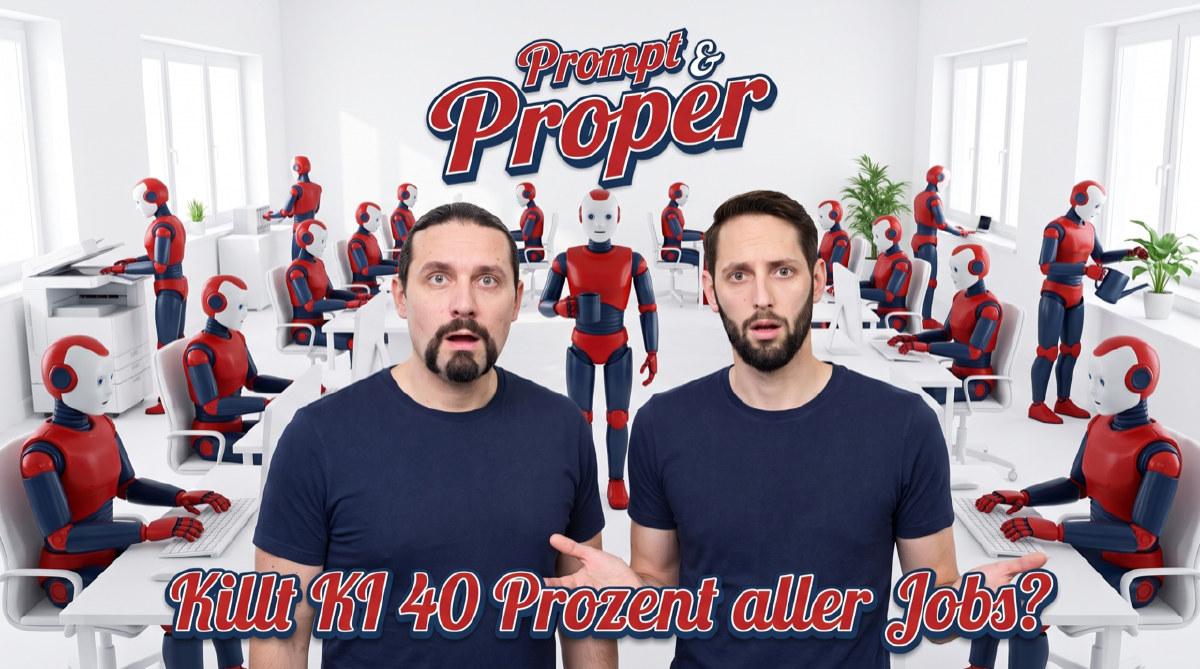
The CEOs of the big AI companies never tire of claiming that AI will wipe out up to 40 percent of all jobs. The headline works. School leavers ask Steffen whether a tech degree is still worth starting, and a German university has gone as far as advising against studying computer science.
In episode 4 of Prompt & Proper, Steffen Ochsenreither from Swiss Post and I take that number apart. What is left afterwards sounds far less dramatic and changes considerably more in practice. The episode is in German, and this post captures the core of the conversation.
Whoever Puts the 40 Percent Out There Is Selling Licenses#
When the CEO of one of these start-ups walks on stage and explains how the world works, he did not come up with it on the spot. It is a marketing pitch, agreed with his marketing team. What bothers me is less the pitch than the fact that we fall for it. The AI echo chamber is large, and inside it the number gets passed along until it sounds like a finding.
The economics behind it are simple. AI is brutally expensive, it demands massive infrastructure investment, and spending is a multiple of revenue. Steffen brought the numbers: in 2026, Google, Microsoft, Meta and Amazon together spend two billion dollars a day. Around 1.3 billion people worldwide use AI, the vast majority of them for free. To cover those two billion, each of them would have to pay roughly 600 dollars a year. We are nowhere near that.
Private investors and VCs no longer write checks of that size. So they go to the stock market. And there, a productivity revolution sells better than an infrastructure bill. Neither of us disputes that there are real productivity gains, I notice them myself every day. But the leap from “this makes me faster” to “40 percent of jobs disappear” is not in any data.
Interest Rates Explain the Layoffs Better Than AI Does#
Look at the bigger picture. When Covid hit, central banks cut base rates and money got cheap. At the same time we had a skills shortage, and many companies had to catch up on the digitalization they had slept through. So they hired, in places well beyond what they needed. Given the situation, that was the right call.
Now central banks are raising rates again. Money gets scarcer, investment gets more expensive, and then you cut overcapacity. That is exactly what is happening.
So when a CEO has to announce layoffs because too many people were hired or a product no longer earns what it used to, that is bad news. He sits down with the marketing team, and there it is: AI, plus the tech bros with their 40 percent. “We planned badly” turns into “we became more productive thanks to AI”, and the share price goes up instead of down.
Steffen has the number that fits. Most of the layoffs started six months before ChatGPT was released, long before agentic coding. Either all these companies are remarkably good at seeing the future, or something else is going on. On top of that, hiring numbers for software developers have stayed roughly at pre-2022 levels, including at the large players. They say they could let 20 to 40 percent of the workforce go, and they keep hiring in parallel.
Steffen added a point that matters especially for manufacturers. There, the core business is the product, the screw. Data science and AI sit on top to optimize production. During the hype years of 21 and 22 a lot of people were hired for exactly that, and many of those initiatives died along the way. When money gets tighter, the things sitting on top go first. The result looks like AI-driven job loss and is not.
What the Studies Say#
This has been examined properly by now. Yale and Brookings see no sign of AI-driven mass job loss through mid-2025. The KOF in Switzerland does see AI leaving traces, but finds no evidence of people losing their jobs because of it.
What does show up is a Stanford finding: companies are hiring fewer junior people. I see the same at Zühlke. We hire fewer juniors because our clients want fewer juniors. That has consequences, and we talk about them too little.
Why Juniors Feel It First#
Steffen’s explanation: AI augments the user, and that augmentation is exponential rather than linear. So a senior gets more out of it than a junior does.
Then there is behavior. Juniors work heavily with the agent and rarely question the generated code. Copy and paste existed with Stack Overflow too, but back then you still had to fit the snippet into your overall construct. Today you say “go fix” and do not even bother with the prompt. What companies expect from a senior is that they question the output and can judge it.
We have already seen the pattern in teams: juniors generate a lot of code, and seniors spend more time reviewing it than building anything themselves. The team does not get more productive from that.
University Education Has to Change#
I lecture at universities of applied sciences, and the question of what a degree is still worth and what to study has arrived there. When Steffen and I studied, programming and algorithms were front and center. From what I discuss with other lecturers and professors, something else is moving to the front: developing and operating whole applications end to end.
Graduates should be able to build a product along the entire value chain, run it, monitor it and judge whether it is any good. That lifts the junior straight to what counts as expert today. Once the first of them reach the job market, the interesting question becomes what the new expert is.
Roles Get Broader, Teams Get Smaller#
What AI does in general, Steffen says, is lower the barrier to entry for anything. I can suddenly hold a conversation with a lawyer and at least sound like one. Across business analysis, engineering and product management you end up passably good everywhere without being the expert anywhere. That makes it possible to merge job profiles and drop the handovers between roles. The product comes out of one head, in one piece.
His picture for it is the carpenter. He has the piece of furniture in his head before he starts. He used to plane by hand, today he uses power tools and is far quicker. He still needs the whole picture, and by now he handles the marketing, the sales and the shipping himself.
That matches what we see in projects. Roles along the value stream are getting broader. The PO keeps the product vision and codes the first features directly, particularly where everything is source code and neither Jira nor Confluence is in the way. The button that should turn green is no longer a ticket in that world. At the same time the software engineer grows towards architecture, quality assurance and DevOps.
My hypothesis, the one I keep putting in keynotes: product and service teams will collapse to 3 plus minus 2 people, supported by agents. Agile formulated 7 plus minus 2. In the agentic era it becomes 3 plus minus 2, and it may well be a single person developing a complete product end to end.
Steffen thinks that is achievable because much of what eats time today disappears. Writing tickets, documentation, taking requests, building mockups. An agent that automatically files a ticket with a proposed bug fix on every crash or user request already exists in rudimentary form. You look at the backlog once a week and work through it. That is a different quality from what we could do before.
The New Bottlenecks#
The interesting question is where the bottleneck sits now. It is no longer coding. The first one is review. Many of my colleagues say they spend half their day or more on pull requests generated by agents, or by juniors working with agents.
The second one I find almost more interesting, and it sits right at the start. With this technology we can build anything. Not everything is worth building. Team sizes are holding steady for now, and budgets are annual and holding steady too. So for the same money we simply produce more features. The bottleneck is deciding which of them deserve to exist.
How to Validate Before You Build#
Something usually starts with an idea, and behind every idea sits a hypothesis. You have to extract it: which customer gets which value here? If the button should be green and a calculation appears behind it, what exactly is the benefit?
Once the hypothesis is written down, the leading indicators come next. And I do mean before building: how would we recognize that this hypothesis holds? That can be a quick prototype with an agent. It can just as well be an interview with potential customers or stakeholders. Classic UX techniques get more important through this, otherwise we build a great deal and pile up technical debt.
Steffen pushed back immediately: the barrier for the PO is low, so will he really validate all of it? He will not. And yes, personal taste is winning regularly right now. Things get built without much thought. You could ask the agent whether a feature makes sense. Nobody does. Shipping more counts as better, and that is going to come back and bite us. We see more output, the outcome does not follow, and maintenance costs go through the roof.
What to Measure Instead#
Steffen is blunt about the KPIs in common use: token consumption is not a KPI. Number of pull requests is not a KPI. Number of Jira tickets closed is certainly not one. The only clean measurement would be building the same project twice, once with AI and once without, and for good reasons nobody does that. Until then a lot of it rests on how productive developers subjectively feel.
My recommendation is a book from 2018: “Accelerate: The Science Behind DevOps” and its four DORA metrics. They are the only scientifically grounded metrics for software delivery performance, and they hold up unchanged in the AI era:
- Lead time. The time from code commit to production.
- Deployment frequency. How often do you deploy to production? Deployment is not the same as release, and that is what a clean feature toggle setup is for.
- Mean time to recovery. If you deploy often, systems will occasionally go down. How long until you are back online?
- Change failure rate. The percentage of deployments that caused a failure.
When I measure software delivery performance I add customer satisfaction and team satisfaction on top. How happy the team is tells you a lot about the rest.
The Take-Away#
Steffen’s conclusion is the sentence executive floors should write down:
“More outcome does not equal more good outcome.”
AI is not taking your job. It is widening it. The end-to-end view gets more important, roles grow together, and the bottlenecks move to review and to the start of the chain. And sometimes it pays to step back to a book from 2018 that still holds up eight years later.
If you enjoy the episode, subscribe to Prompt & Proper on Spotify, Apple Podcasts, Amazon Music or YouTube and tell us which AI topic you are wrestling with right now. All episodes: promptandproper.ai.