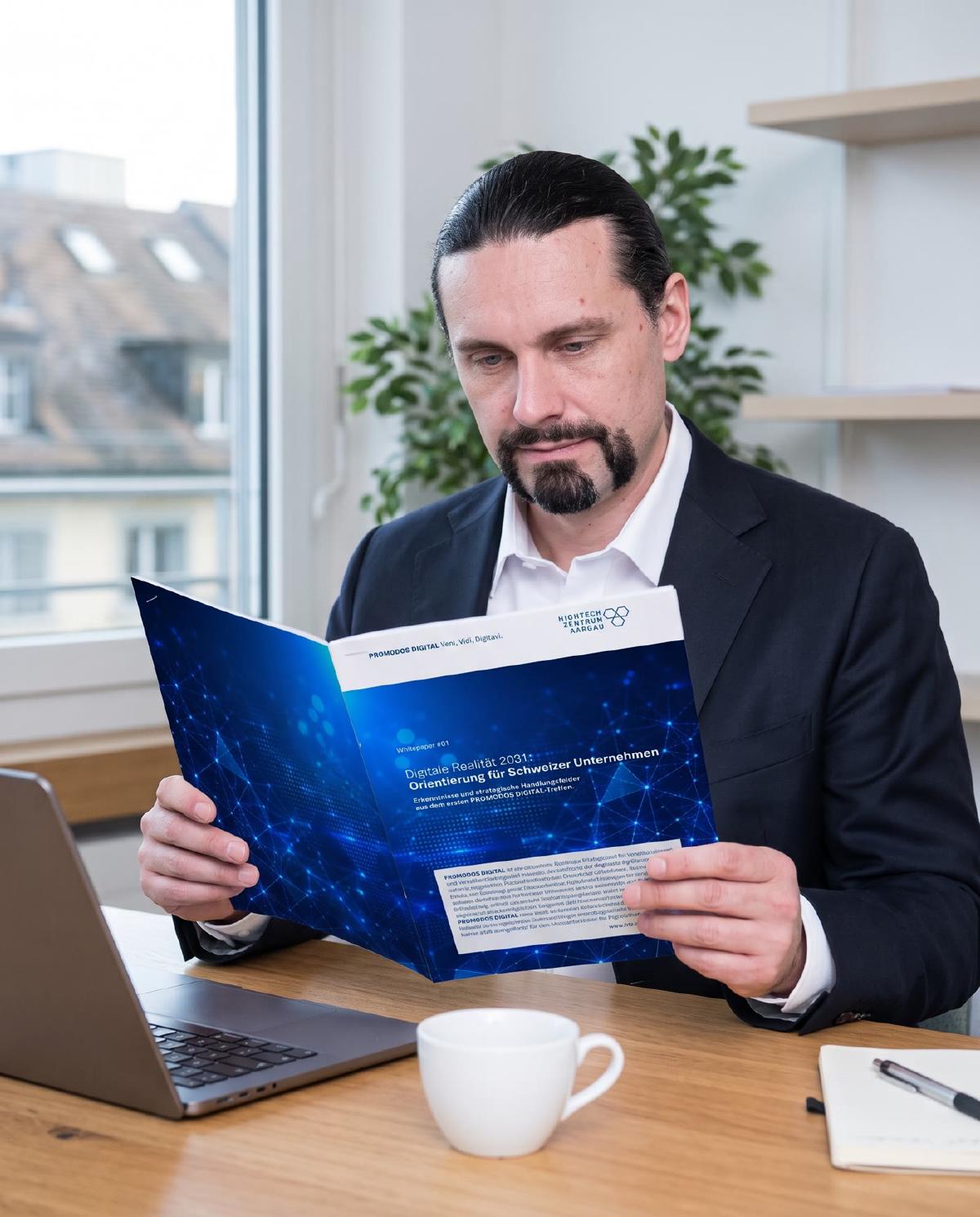
What will the digital reality of Swiss companies look like in 2031? That question opened PROMODOS DIGITAL on 7 September 2026 in Baden, a dialogue forum run by the Hightech Zentrum Aargau. About 20 people from business, research, public administration and politics meet there two to three times a year. I am one of them. This whitepaper came out of the first round. It is written for boards and executive teams.
What changes#
The discussion painted an optimistic picture. AI becomes basic infrastructure like electricity, and the advantage goes to companies that connect AI with their own knowledge. Customers, in B2B too, expect more in less time and will not pay more for it. Software development shifts from programming to specifying. Roadmaps get shorter, and executives need enough understanding of technology to make the decisions themselves.
The paper records the doubts as well. Not every AI is a language model, and whether the current billions in investment will earn the expected returns is open. Dependencies on cloud, models and energy remain. The group considered full digital autarky unrealistic. What matters is knowing those dependencies and being able to switch providers when needed.
Four priorities for the coming months#
- Build AI competence at every level. Decisions on investment, opportunity and risk cannot be delegated. Whoever makes them has to understand what AI can do and where its limits are.
- Give people time to experiment. Day-to-day business leaves none, and under pressure people stay with the old routines. Clear rules belong with it: which tools and which data are allowed, and how results get checked.
- Assess your own data before money goes into AI projects. The question is which data a concrete task needs, not how much data you can collect.
- Run a risk audit on data sovereignty and cybersecurity, including a rehearsed recovery from a ransomware attack.
Where Switzerland has opportunities#
Switzerland does not have to compete with the large technology companies from the US and China. The paper sees its opportunities in physical AI and robotics, built on its machine and precision engineering industry, in edge AI and local models, and in technology-friendly policy that keeps regulation to what is necessary.
Download the whitepaper (German) from the Hightech Zentrum Aargau
Published by the Hightech Zentrum Aargau. Edited by Bernhard Isenschmid, Dr. Anke Sanz-Velasco, Dr. Ecaterina Puricel and Dr. Maja Mattle-Greminger.