Welcome to Edition 10 of The CAIO.
Swiss telecom Sunrise cut 147 jobs this year and now says up to 450 more could go, citing AI and automation. A study of more than half a million developers found that AI tools raised the amount of code by 958 percent and the number of releases by 20 percent, and customers barely noticed. Both stories have the same gap in the middle. The tool arrived, and the process it was dropped into stayed the same. A layoff does not change that. Neither does a licence.
AI software now acts faster than a human can approve it. More and more companies and users are therefore asking: can AI be controlled at all?
A growing number of studies show that the question is a fair one. According to Gartner, more than 40 percent of agentic AI projects will be cancelled by the end of 2027, because of rising costs, unclear value or inadequate risk controls. In the same forecast, Gartner expects at least 15 percent of day-to-day work decisions to be made autonomously by AI agents by 2028. A global survey of executives by the Capgemini Research Institute points the same way: trust in fully autonomous agents fell from 43 to 27 percent within one year, while usage went up. The more experience companies gain with AI agents, the more clearly they see their limits and risks.
The heads of the big AI labs publicly warn against their own models and call for slowing down. Weeks later, one release follows the next anyway. In episode 10 of Prompt & Proper, Steffen Ochsenreither from Swiss Post and I ask what sits behind this fear campaign. Our answer: the risk lies less in superintelligent models than in agents we have given too many rights. The episode is in German, and this post captures the core of the conversation.
Welcome to Edition 9 of The CAIO.
From October every AI request at Zühlke is billed to the team that made it. Token prices more than halved this summer, and the bill is still the number to watch. A cheap model that fails twice and ends with a person on the case costs more than the expensive one. The same agent on the same prompt takes two routes and sends two bills. My own dark factory burned one billion tokens over several days for a game I would not pay for. Almost no company has a person whose job is to watch that bill and switch.
Welcome to Edition 6 of The CAIO.
June had one lesson that kept landing on a desk where it had rarely landed before: finance. For two years we treated AI tokens as free and competed on how many we could burn. In June the bill arrived. The price of each request had fallen, which is exactly why usage exploded and the total cost climbed past what anyone had budgeted. AI cost control became a CFO topic as fast as it became ours.
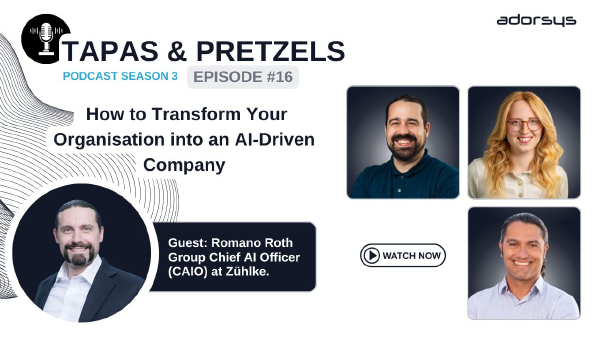
I joined the adorsys Tapas & Pretzels podcast for a conversation with co-hosts Tim and David, fellow Chief AI Officer, about the question every leader is now asking: how do you move AI from isolated experiments to a company-wide capability? We talked about token economics, what the Chief AI Officer role actually demands, why capability beats tools, the trust gap that governance exists to close, and why most companies are speeding up broken processes instead of rethinking them.
Welcome back to The Cybernetic CxO, a monthly newsletter for CTOs, CIOs, and digital transformation leaders navigating the AI era.
April delivered the most-read post in this newsletter’s history: a Swiss medical professional vibe-coded a patient management system, put it on the open internet, and an engineer needed thirty minutes to get full read and write access to every patient record. The post travelled because the story is concrete, the legal damage is real, and the lesson applies to almost every organization I talk to.
Welcome back to The Cybernetic CxO, a monthly newsletter for CTOs, CIOs, and digital transformation leaders navigating the AI era.
March was a breakout month. My reach nearly tripled compared to February. My post about the 750 billion dollar fear narrative became a high-performing post. And out of 32 posts this month, 6 of the top 7 were about the same topic: AI and jobs.
Summary # The NZZ article examines “Workslop” - a new term for sloppy work produced through careless AI use. While tech companies promote AI as a productivity miracle, the reality shows a darker side: AI makes it easy to produce polished-looking but often substanceless or incorrect content. This creates extra work for colleagues who must clean up the mess, damages trust in teams, and ultimately destroys the productivity AI was supposed to improve.
The CTO’s copy of the model. Same idea, seen from the technology organization: architect for simplicity, give teams enough autonomy to be accountable, scale platform engineering so that autonomy does not turn into forty snowflakes, and embed AI with governance that people can follow without asking permission twice a day.