When people talk about AI and jobs, they almost always mean developers. The larger part of the working world sits elsewhere, in offices, in HR, in marketing, in administration.
In episode 3 of Prompt & Proper, Steffen Ochsenreither from Swiss Post and I look exactly there. And we quickly land on a point that has nothing to do with technology. The episode is in German, and this post captures the core of the conversation.
In today’s rapidly evolving landscape, businesses are constantly confronted with changing customer needs, increased competition, and a significant shortage of skilled workers. Agility and speed are no longer optional, they are critical to survival.
Explore the fusion of AI with DevOps and platform engineering to automate workflows, enhance efficiency, and drive innovation.
What This Talk Covers # The convergence of AI, DevOps, and Platform Engineering is reshaping how we build and operate software. AI is no longer just a feature we ship, it is becoming part of how we ship. From intelligent CI/CD pipelines to AI-assisted incident response, the developer experience is changing fundamentally.
Romano Roth advocates the importance of companies focusing on the developer experience and enabling developers to concentrate on creating business value.
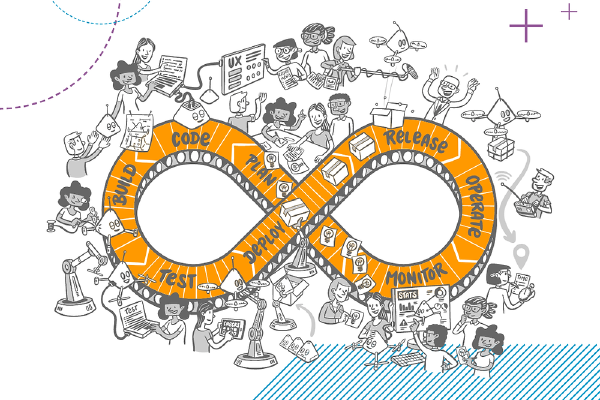
Have you ever wondered what “DevOps Engineers” actually do? What does “DevOps” even mean actually? This blog post aims to explain the concept of DevOps and the value that it
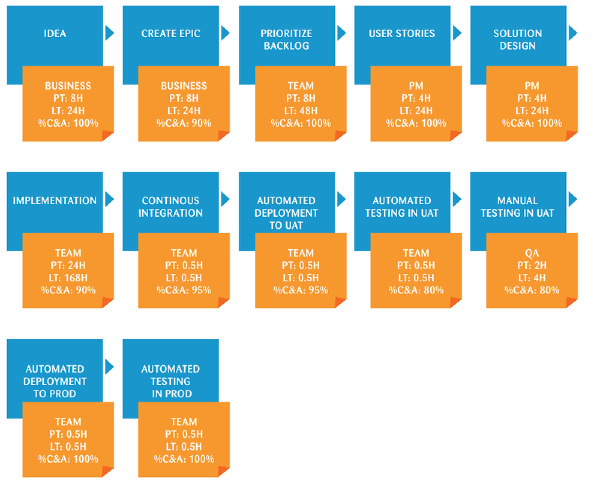
Value stream mapping is a lean management method for improving the flow of value from idea to production. It offers insight into the efficiency of an organisation and can help to identify bottlenecks and improve value flow. The primary goal is to eliminate any waste.
Is DevOps really the reason why testing and quality assurance (QA) employees are being increasingly automated out of a job? Pia Wiedermayer, Head of QA, and Romano Roth, Head of DevOps, discuss different ways to incorporate the wealth of experience of testing and QA specialists into the agile team culture.
When we are talking about traditional testing, we are talking about the V-model which is used in waterfall projects. We do requirement engineering, we write down features for our software, then we break them down and then write stories which are then given to the developer to implement this story. The developer then codifies this and then writes unite tests and integration tests.
Continuous Deployment is the final, most aggressive step in the CI/CD progression. CI proves the code builds and the unit tests pass. Continuous Delivery proves the artifact works in a production-like environment. Continuous Deployment removes the last manual checkpoint: if every test along the way is green, the change goes straight to production. No “deploy” button, no Friday-afternoon release window, no human in the loop for the final step.
Continuous Integration ends with a tested artifact. That sounds great, but a green build does not mean the software actually works in a realistic environment. Unit tests run in isolation. Integration tests run against mocks. Until you put the software somewhere that looks like production and exercise it under real conditions, you have not really proven anything. Continuous Delivery is the step that closes that gap.
In traditional software development, software is merged and tested by all developers in one big single integration step that usually takes weeks or even months. Since this only happens every few months, this step is very time-consuming.
In traditional software development, integration was a single, painful event. Every developer worked in isolation for weeks or months, and at the end the team merged everything in one big bang. The integration step took weeks, sometimes months. Conflicts piled up, bugs hid in the seams between modules, and nobody could say with confidence whether the system actually worked. Continuous Integration was invented to make that pain disappear.