Flagsmith’s eBook on feature flags at enterprise scale. I wrote the introduction.
The argument in it: feature flags separate deployment from release, and that separation is what makes deployment frequency, one of the four DORA metrics, movable at all. Without it, a team can only deploy as often as it dares to release. With it, small changes go out several times a day and the blast radius of each one stays small.
I recently joined Ben on the We Chat Tech podcast for a wide-ranging conversation about DevOps, leadership, career growth, and the future of AI in software engineering. Over 23 years at Zühlke, I have worked across industries helping organizations transform how they deliver software. In this episode, we covered everything from the fundamentals of DevOps to the skills that future engineers will need.
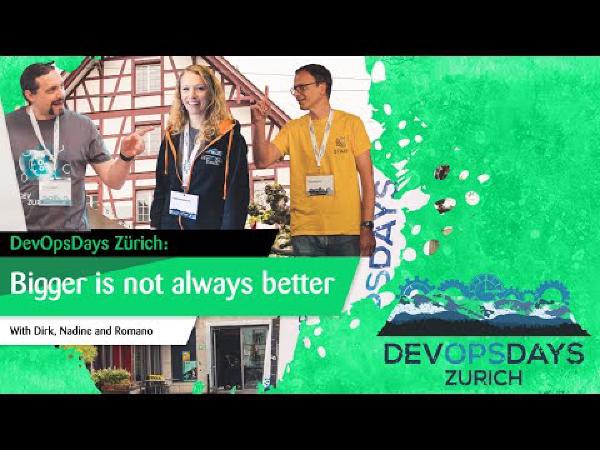
On October 4, 2024, the global DevOpsDays Organizer Summit took place in Antwerp, bringing together organizers from DevOpsDays events around the world. Our team from DevOpsDays Zürich delivered a presentation titled “Bigger is Not Always Better.” I was not able to attend in person due to another conference, but my co-organizers Nadine and Dirk absolutely rocked the stage. Here is the story of why we decided not to scale our sold-out conference.
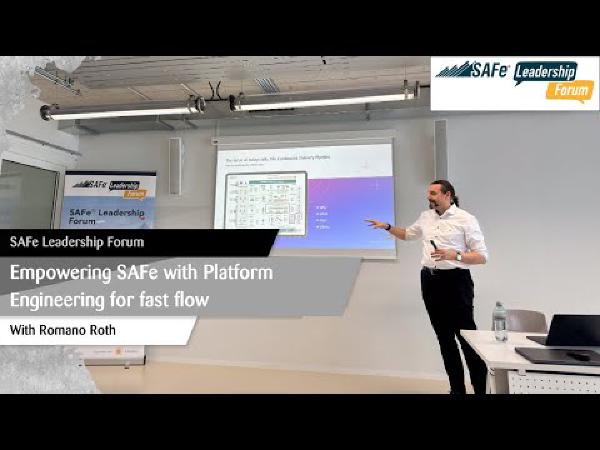
What are the railroad tracks of your SAFe agile release trains? How are they built, and why do they matter so much? In this talk at the SAFe Leadership Forum, I explore how platform engineering creates the foundation that enables agile teams to continuously deliver value for fast flow.
In September 2024, I had the privilege of delivering a keynote at the Roche DevOps Conference in Poland. The topic: how to architect for continuous delivery. This is a subject close to my heart, because after more than two decades of working in software delivery, I keep seeing the same fundamental patterns that separate high-performing organizations from those that struggle.
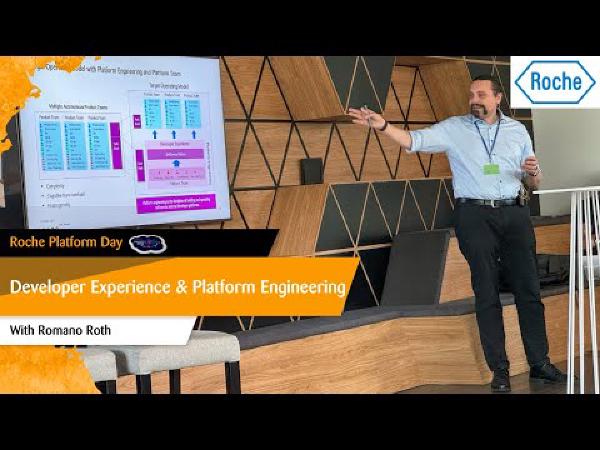
Is DevOps dead? That claim keeps appearing on the internet, with people arguing that platform engineering is taking over. In this talk, which I gave at the Developer Experience Conference at Roche in Poznan, Poland, I explain why DevOps is absolutely not dead and why platform engineering is the key to making it actually work at scale.
When the CEO or CIO comes to you and says “We need AI in our development process,” the right response is not to start implementing immediately. The right response is to ask: why? In this talk at Conf42 Platform Engineering, I walk through the complete journey from identifying value stream bottlenecks to implementing AI-augmented DevOps on a real platform, including a live demo.
Have you ever wondered how companies build those impressive AI applications and keep them running reliably in production? In this video, I take a deep dive into MLOps, the discipline that makes it possible to continuously develop, deploy, and improve machine learning solutions at enterprise scale.
On July 19, 2024, the world witnessed one of the largest IT outages in history. A sensor configuration update from CrowdStrike, pushed to all Windows systems at 4:09 UTC, caused 8.5 million Microsoft Windows PCs to crash worldwide. Airlines, banks, hospitals, government agencies, stock exchanges, and countless other organizations were brought to a standstill. In this video, I break down what happened and, more importantly, what you can do to prevent something like this from happening in your organization.
Banking software must be secure, reliable, and trustworthy. But many banks still rely on traditional development methods that are slow, risky, and inefficient. In this video, I explore three modern software development practices that are fundamentally changing how banks build and deliver software: continuous deployment, test-driven development, and feature flags.
Intdiuction the the eBook Moving to Modern Development Practices in Banking: A Playbook
Flagsmith’s playbook for banks that want to modernize how they build software without trading away the controls a regulator expects. I wrote the introduction.
Banking is where the tension between speed and safety is sharpest, and where the usual answer has been to pick safety and live with the release cycle. The playbook works through the alternative: continuous delivery, feature flags, platform engineering, and the audit and access controls that make all three acceptable in a regulated environment.