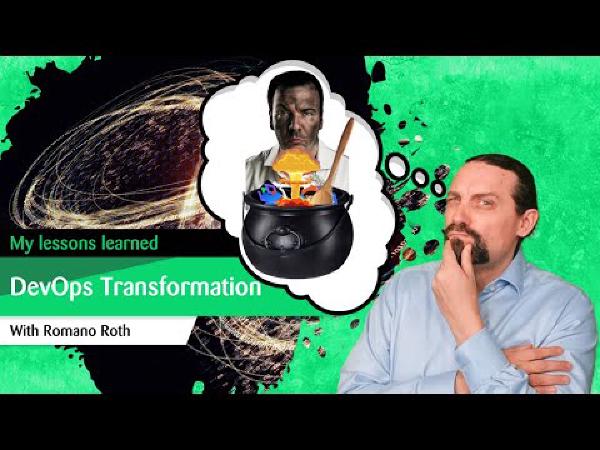
DevOps transformations look simple on paper. Take an existing environment, add the Spotify model, throw in SAFe, sprinkle some Team Topologies, add DevOps and platform engineering, stir well, add as many tools as possible, and stir again. What happens? It crashes. And people say “DevOps is bullshit.”
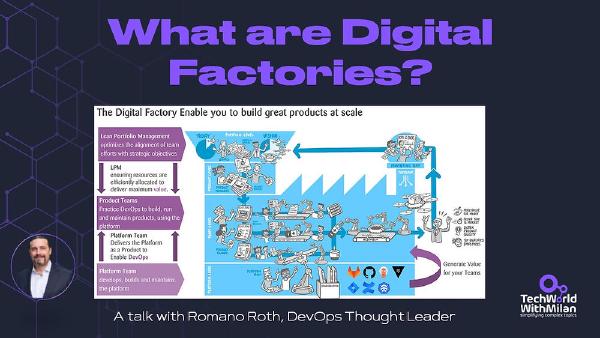
a talk with Romano Roth, DevOps Thought Leader and Dr. Milan Milanović Architecture Thought Leader. Source: https://newsletter.techworld-with-milan.com/p/what-are-digital-factories
In this podcast episode, I have a conversation with Peyton Einhaus about one of the most challenging aspects of any transformation: dealing with resistance. Whether you are running an agile transformation, a DevOps transformation, or any organizational change, resistance is always present. The question is how you handle it effectively.
Embedded and IoT devices are becoming increasingly popular in today’s world. These devices are used in various industries, such as healthcare, manufacturing, consumer goods and home automation. Ensuring the quality of these devices is crucial to ensure their reliability, safety, and functionality. But how to do that?
Sometimes in the world of platform engineering, we need to pause and appreciate the digital landscapes we build every day. This short, playful video is a guided meditation for platform engineers. Find a comfortable position, take a deep breath, and let me guide you through the world you create.
Every DevOps enthusiast faces the same challenge at some point: you know DevOps works, your team knows it works, but the decision makers want proof. They want a business case. In this talk at ContainerDays 2019, I break down a practical framework for convincing CIOs and managers to fund your DevOps transformation.
You want to do DevOps. Your team wants to do DevOps. Even your CIO wants to do DevOps. But then comes the inevitable question: “What is the business case?” In this five-minute Ignite Talk at DevOpsDays, I share a simple but powerful tool to convince decision makers that DevOps is worth the investment.
Many companies are suffering from a lack of alignment between business and IT, silo thinking, and inefficiencies in product development, while time to market is becoming increasingly important.
The Problem # These companies try to adopt DevOps in their organizations, but unfortunately, sometimes the DevOps approach is misunderstood, wrongly implemented, and it does not scale as expected.
I had the honor of being interviewed by 📈 Matt Warcholinski 💾 from Brainhub in his 𝐏𝐨𝐝𝐜𝐚𝐬𝐭🎙️ on 𝐁𝐞𝐭𝐭𝐞𝐫 𝐓𝐞𝐜𝐡 𝐋𝐞𝐚𝐝𝐞𝐫𝐬𝐡𝐢𝐩.
At The DEVOPS Conference, I presented on a topic that has been at the heart of my work for over two decades: how to architect for continuous delivery. This talk covers the broken value stream I see in most companies, why product thinking matters more than project thinking, the science behind software delivery performance, and how platform engineering enables organizations to scale DevOps through digital factories.
At the State of DevOps in Switzerland 2023 event, I joined Adrian Kosmaczewski from VSHN to present the latest findings on DevOps adoption in the Swiss market. Adrian shared four years of survey data, while I focused on how to successfully scale DevOps through platform engineering and the concept of the digital factory. This event brought together DevOps professionals both on-site and virtually for presentations and a lively panel discussion.
After eleven sessions building a full DevSecOps pipeline with GitHub — covering Software Composition Analysis, License Compliance, SAST, Container Scanning, Secret Detection, DAST, Pull Requests, Scheduled Pipelines, and Vulnerability Management — Patrick Steger and I close the series with our recommendations. What works on GitHub, where the gaps are, and what we would tell anyone setting out to build the same pipeline.