The heads of the big AI labs publicly warn against their own models and call for slowing down. Weeks later, one release follows the next anyway. In episode 10 of Prompt & Proper, Steffen Ochsenreither from Swiss Post and I ask what sits behind this fear campaign. Our answer: the risk lies less in superintelligent models than in agents we have given too many rights. The episode is in German, and this post captures the core of the conversation.
The price per token has been falling for months. The bill keeps rising anyway. In episode 9 of Prompt & Proper, Steffen Ochsenreither from Swiss Post and I compare what we see in our organisations, and it is the same pattern on both sides: the more we develop agentically, the faster consumption grows, and it grows faster than model prices drop. The episode is in German, and this post captures the core of the conversation.
A dark factory is a factory where you can switch the lights off, because nobody is standing on the floor anymore. In China, phones are already built that way. In episode 8 of Prompt & Proper, Steffen Ochsenreither from Swiss Post and I take that concept and put it on software development: goal in, finished software out, no human in between. The episode is in German, and this post captures the core of the conversation.
We have spent a lot of this podcast on the technology and on the effects of AI. In episode 7 of Prompt & Proper, Steffen Ochsenreither from Swiss Post and I take on the transformation itself. Not what AI does inside a company, but how you point a company at AI. The episode is in German, and this post captures the core of the conversation.
As Chief AI Officer I am supposed to put an AI strategy in place, and the headline alone turns into work. AI-First, AI-Native, AI-Enabled, AI-Ready, AI-Shaped, AI-Augmented. In episode 6 of Prompt & Proper, Steffen Ochsenreither from Swiss Post and I go through the terms and end up somewhere the question does not suggest. The episode is in German, and this post captures the core of the conversation.
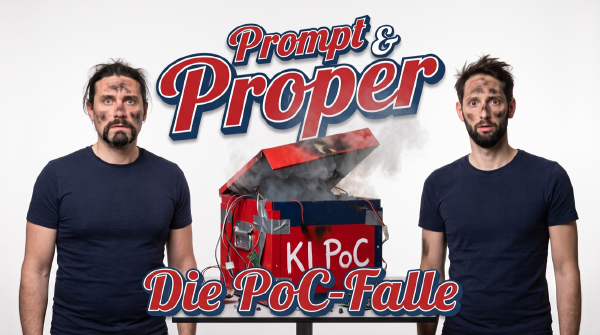
A proof of concept is quick to build these days, and that is exactly where the problem starts. Classically around 70 percent of all PoCs got stuck in the PoC stage. With AI, going by the studies Steffen follows, the rate sits beyond 90 percent.
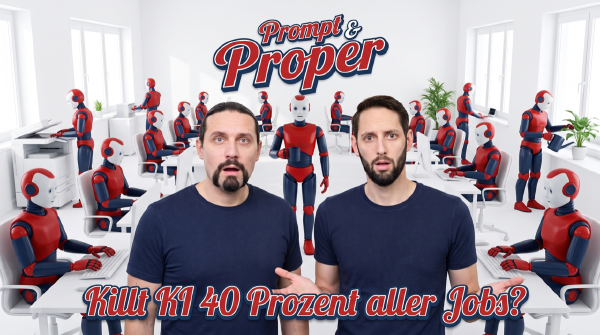
The CEOs of the big AI companies never tire of claiming that AI will wipe out up to 40 percent of all jobs. The headline works. School leavers ask Steffen whether a tech degree is still worth starting, and a German university has gone as far as advising against studying computer science.
When people talk about AI and jobs, they almost always mean developers. The larger part of the working world sits elsewhere, in offices, in HR, in marketing, in administration.
In episode 3 of Prompt & Proper, Steffen Ochsenreither from Swiss Post and I look exactly there. And we quickly land on a point that has nothing to do with technology. The episode is in German, and this post captures the core of the conversation.
On LinkedIn I keep reading that agentic coding makes teams 10x more productive. It is good marketing. It has little to do with what we measure in real projects.
In episode 2 of Prompt & Proper, Steffen Ochsenreither from Swiss Post and I take that number apart. And we talk about the other side of the same coin, the one that gets far less airtime: what tokens actually cost, and how solid the economics behind them really are. The episode is in German, and this post captures the core of the conversation.
Most AI projects do not fail on the technology. They fail earlier, on a thinking error: the hunt for one giant use case, the lighthouse project.
This is the launch of my new podcast Prompt & Proper, which I host together with Steffen Ochsenreither from Swiss Post. Every two weeks, in German, hands-on and without the marketing speak. Episode 1 takes apart what we call the “giant use-case fallacy”: why the management signal “we are doing AI now” so often ends in nothing, and what a good first use case actually needs. The episode is in German, and this post captures the core of the conversation.
I joined Lisa Stähli on the Hello 50:50 World podcast, the show with the mission to make tech more humane, for a conversation about what actually happens when software teams add AI to the way they work. We talked about how AI is reshaping software engineering, DevOps and agile ways of working, where the real bottlenecks sit, the human cost of moving faster, and why the organisation you build around the technology is what decides whether AI helps or hurts.
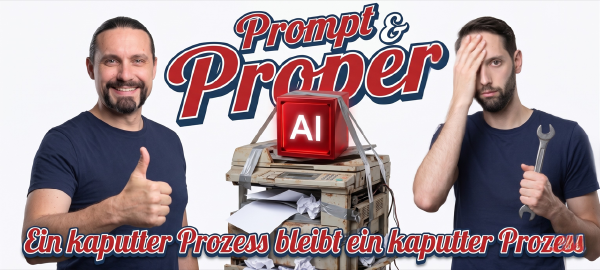
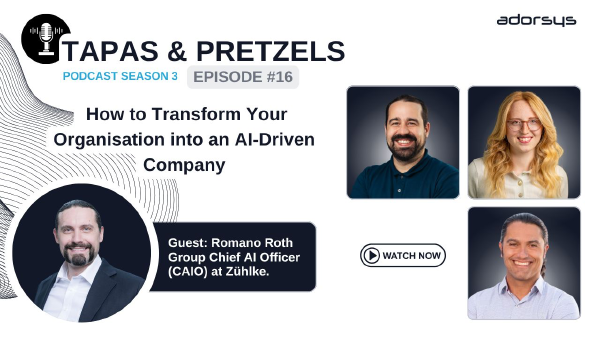
I joined the adorsys Tapas & Pretzels podcast for a conversation with co-hosts Tim and David, fellow Chief AI Officer, about the question every leader is now asking: how do you move AI from isolated experiments to a company-wide capability? We talked about token economics, what the Chief AI Officer role actually demands, why capability beats tools, the trust gap that governance exists to close, and why most companies are speeding up broken processes instead of rethinking them.